Accounts Receivable SaaS: Choosing Your AR Automation Software

Contents
35% of mid-sized firms still rely entirely on manual AR processes, according to a 2025 study. That may not seem like much, but when you consider the benefits (20–35% reduction in days sales outstanding (DSO), 40–60% less AR processing time, 30% average improvement in cash application accuracy, etc.), automating your processes with accounts receivable SaaS (Software as a Service) is clearly a worthwhile investment.
So the question is less about whether you should adopt AR Saas and more about which platform to choose. Here, we can help.
We’ve evaluated the top products on the market to help you find the best one for your business needs. But first, we’ll explore core features of AR SaaS platforms and lay out more benefits for you to consider.
What is Accounts Receivable SaaS?
SaaS accounts receivable solutions are cloud-based platforms that automate the entire order-to-cash lifecycle. Instead of installing the software on your servers, your business accesses it over the internet through a subscription.
So, what tasks does it generally automate? These usually include sending invoices, tracking payments, following up on overdue accounts, reconciling incoming payments, and forecasting cash flow, among others.
This saves your teams a lot of the time-consuming, repetitive, and error-prone manual work associated with traditional accounting methods.
Perhaps you’re already using on-premises AR software and thinking, why switch to SaaS? With on-premises software, you deal with higher upfront costs and the manual effort of keeping up with updates and maintenance yourself. It also limits you to your server location and requires additional on-site infrastructure to scale. SaaS removes many of these difficulties, as we’ll explore later.
Key Features of Leading Accounts Receivable Software as a Service
An AR automation software may come with all the frills, but you shouldn’t judge the best platform by how many features it offers. Instead, look for core capabilities done well. After these priorities, anything else is a bonus.
Invoice Delivery
The appeal of automation software is that it takes those niggly, repetitive tasks off your hands so you can focus on the bigger picture. Invoice delivery is no exception.
Software platforms automatically generate invoices using customer and contract data (in the customer’s preferred currency, no less), validate this information before sending, and then track delivery and receipt. Not only that, they’ll integrate with your existing systems, such as your ERP, giving you a consistent view of outstanding invoices and payments.
Collections
Chasing overdue invoices takes a huge toll on your team’s time. And the paradox is that the more accounts you manage, the more unmanageable it becomes.
AR automation takes much of the manual burden out of this process by scheduling payment reminders, sending follow-ups at appropriate intervals, and prioritizing accounts based on factors such as overdue balances, payment history, and risk.
A truly top platform, however, will go further than standard collections automation, letting you customize workflows for different customers. For example, a long-standing client with an occasional late payment may receive a different approach than a consistently overdue account.
Payment Processing
Not only does AR software make your life easier; it also benefits your customers with a user-friendly and secure payment portal. These accept multiple methods, including ACH and credit cards, making it as simple as possible for your customers to view and make payments, while improving their experience.
Of course, by removing friction between receiving an invoice and completing payment, you also benefit from reducing DSO and saving your team time spent manually chasing payments.
Cash Application
Without AR SaaS capabilities, you must manually match and post incoming payments to open invoices. This takes a lot of resources.
But a platform can do this for you, supporting even complex matching by identifying which invoices a payment relates to and updating the corresponding records. A leading platform will achieve this even when payments cover multiple invoices or arrive in partial amounts.
This reduces manual reconciliation, but it also helps prevent posting errors and keeps your records up to date.
Reporting
Knowledge is power, but generally one reserved for smaller accounting teams. This is because, as the number of accounts you manage rises, it becomes harder to manually keep track of trends, such as which customers pay on time and which are commonly at risk of becoming overdue.
AR automation extends this luxury to larger accounting companies, too, providing invaluable real-time insights without managing an overwhelming spreadsheet. Instead, you receive up-to-date customer behavior patterns.
With this information, you can easily take targeted action to improve customer satisfaction or identify and reduce risks.
Benefits of AR Automation Software
We started this article with some statistics highlighting the advantages of automating your AR processes, but the benefits go beyond the numbers. Here are some further ways that investing in an AR SaaS product can improve your business.
Accelerated Cash Flow and Drastically Decreased DSO
Automation reduces your DSO by making the AR process more efficient, removing friction and decreasing delays. It does this with prompt invoice delivery, scheduled reminders, integrated payment portals, and reconciliation. The list goes on.
When most people think of the benefit of lower DSO, they think of better cash flow. And while this is a major benefit, it’s not the only one. More timely payments also make financial planning easier, as you can estimate incoming cash more confidently.
A More Efficient and Productive Team
The faster you complete repetitive tasks, the more time you free up for higher-value activities that help your business evolve and expand. This is one of AR automation’s greatest gifts. Traditionally, growth often stunted further growth: more accounts meant more manual tasks and less time for the strategic work that fueled expansion. But with automation on your side, you can scale operations without increasing administrative work at the same rate, because it handles that for you.
At the same time, centralizing all aspects of AR in a single tool means you no longer have to switch between multiple systems and spreadsheets, which reduces errors and simplifies decision-making.
Enhanced Customer Experience
We’ve focused plenty on the benefits of AR automation for you, but what about your customers? It also gives them a smoother experience, ultimately improving your customer relationships. Manual payment chasing can be inconsistent and be received negatively, which damages satisfaction. AR automation prevents this with personalization that enables a more customer-centric approach. It sends timely reminders tailored to the individual’s history and circumstances.
Meanwhile, as we touched upon earlier, easy-access self-service payment portals make it easier for customers to view outstanding invoices and settle balances at a time and with a payment method that best suits them.
Interested in seeing these benefits applied to a real use case? Read about How Interbit Data Decreased Overdues by 44% with Kolleno.
How AI in Accounts Receivable Software Changes the Game
The automation features above are now standard in leading AR SaaS products. But as artificial intelligence becomes more valuable, the bar is rising, and these capabilities are no longer enough to set a platform apart.
While standard automation follows predefined rules, AI can use data and context to autonomously decide what should happen next. This doesn’t mean replacing human expertise, but it does help augment it to improve outcomes.
Here are a few ways it can help:
Agentic Workflows
AI agents coordinate actions across collections, cash application, disputes, and forecasting, rather than handling each task in isolation. For example, an agent can identify an overdue invoice, review the customer’s payment history, and determine the next step under your collection policy. If a payment arrives without a clear reference, another agent can search for a match and update the relevant records.
Predictive Payment and Risk Analysis
AI tools can analyze your customer payment histories and account data to predict their payment behavior and flag those at risk of paying late. This helps your team prioritize collection efforts before overdue balances become hard to recover.
AI-Powered Cash Application
AI and machine learning excel at matching incoming payments with outstanding invoices, even in complex reconciliation scenarios that standard automation may struggle with.
Assisted Communication and Reporting
To help save your time, AI can draft collections emails for human review, using account context to tailor the message. It can also answer questions about past customer interactions and payment updates quickly, without you having to trawl through historic records.
Dispute Prioritization
AI-driven insights help categorize and prioritize customer disputes by how likely they are to impact your cash flow. This means you can draw your attention to the cases that matter most and address issues that could genuinely delay payment.
The Best Accounts Receivable Automation Software for Finance Teams
There are several strong AR SaaS products on the market today, though they don’t offer identical services. Some prioritize certain areas of AR automation over others, so the one that suits you best depends entirely on your business needs.
Kolleno
Best for: A full order-to-cash lifecycle automation experience in one platform.
Kolleno is built to solve specific AR challenges finance teams face, serving as an enterprise-grade operational extension for high-volume B2B businesses.
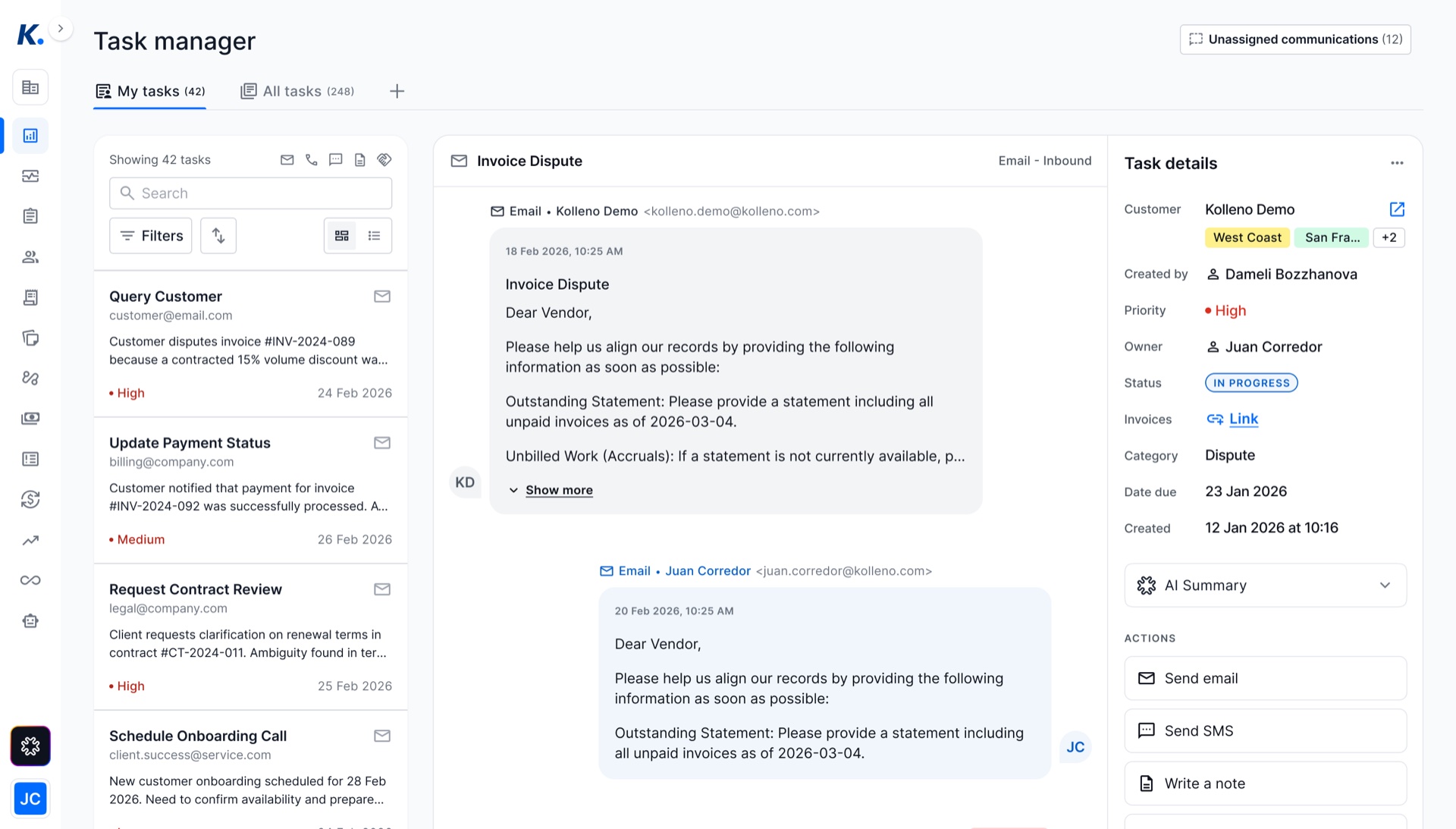
If you’re looking for a SaaS solution that unifies AR, payments, and credit control with AI execution that respects human expertise, Kolleno offers the ideal platform. Task-specific AI Agents act as force multipliers, helping your teams work more efficiently so they have more time to focus on strategy. No area of AR is handled in isolation. Instead, they are coordinated through Maestro AI, Kolleno’s central orchestration layer.
What Makes Kolleno Stand Out?
Kolleno saves you from having to sync your data across the software systems you rely on. It integrates with your ERP, CRM, banks, and mailboxes with real-time, two-way data sync.
Key Features
- Unified SaaS platform for the full order-to-cash lifecycle
- Branded, self-service payment portal
- AI-powered cash application and reconciliation
- Dispute management
- Cash-flow forecasting and AR analytics
- Integrations with NetSuite, QuickBooks, Sage, and other ERP systems
Billtrust
Best for: Mid-to-large B2B companies looking to digitize electronic invoicing and electronic payment capture.
Billtrust is more on the enterprise-focused end of the spectrum. It’s a B2B AR automation platform built for businesses with complex billing and payment processes.
Its main strengths lie in its payment infrastructure and online payments, so if your priority is reducing payment friction, it could be a strong option.
The downside is that for complex invoicing, you still need human oversight to ensure accuracy more than with some other platforms.
What Makes Billtrust Stand Out?
Billtrust is best suited to finance teams looking to introduce smoother payment processes in the manufacturing, distribution, and logistics industries.
Key Features
- Agentic collections workflows
- AI-powered cash application and credit management
- Predictive analytics and cash-flow forecasting
- Autopilot AI assistant that lets you query AR data in natural language
- Buyer payment portal
Versapay
Best for: Mid-size companies and enterprises looking to implement collaborative online billing portals.
Versapay takes a customer-experience-focused approach to AR automation, focusing on collaboration between finance teams’ collection workflows and the customers themselves. This makes it a particularly useful tool for businesses that want to reduce friction in high-touch billing environments.
Because of this emphasis on user interaction, Versapay excels in speeding up dispute resolution and cash application. It also integrates with most commonly used ERP systems for easy data flow, though some users have reported that this integration isn’t as simple as expected.
What Makes Versapay Stand Out?
Versapay provides a shared portal where customers and AR teams can interact directly on invoices and payments in real time, so it’s a standout option for customer-centric AR teams.
Key Features
- Digital invoicing and customer collaboration
- AI-powered collections management and cash application
- Integrated B2B payment processing
- AR analytics, reporting, and cash-flow forecasting
- Two-way communication for dispute management
HighRadius
Best for: Large enterprise corporations handling highly complex accounts receivable needs.
HighRadius is an enterprise-focused, sales-to-cash platform. It’s suited to businesses that manage complex financial processes at scale because it connects multiple AR functions across different systems and business units.
It automates high-volume tasks such as collections prioritization, invoice tracking across customer portals, payment matching, and deduction resolution, while integrations with major ERP systems (including SAP, Oracle, Workday, and Microsoft Dynamics) support complex finance environments.
One thing to consider is that the platform is complex, so some users find implementation difficult. As a result, it may appeal most to teams with the time and internal resources to support it.
What Makes HighRadius Stand Out?
HighRadius offers a broad range of automation capabilities with an AI-powered platform designed to handle complex processes. This makes it a potential fit for large-scale companies struggling to manage intricate work.
Key Features
- Complex remittance capture and payment matching
- Intelligent deduction validation
- Customer AP portal submissions
- AI-driven credit risk assessment and credit management
- ERP integrations across enterprise environments
NetSuite
Best for: Businesses looking to manage accounts receivable within their existing ERP system.
NetSuite is slightly different from the other platforms listed here, as it isn’t a specialist AR SaaS platform. It’s a cloud-based ERP system with accounts receivable built into its wider financial management suite. Because of this, it may be a good choice if you want to manage AR as part of the same system that manages the rest of your business, rather than just connecting them through integrations.
NetSuite also supports complex billing requirements through features such as consolidated invoicing, automated tax calculations, and SuiteBilling for subscription-based businesses.
However, businesses seeking advanced AI-led collections or specialist AR automation may need to assess whether its native features meet their requirements.
What Makes NetSuite Stand Out?
NetSuite’s main advantage is its integration with the wider ERP. Invoices, customer records, payments, and general ledger entries connect within the same system, reducing duplicate data entry and giving finance teams a consistent view of receivables and overall financial performance.
Key Features
- Automated invoice generation and delivery
- Payment processing and invoice matching
- Configurable dunning and collections workflows
- Consolidated invoicing and flexible billing schedules
- Real-time AR reporting, dashboards, and aging analysis
- Native integration with general ledger, cash management, and other ERP functions
Why Choose Kolleno as Your B2B SaaS Solution for Accounts Receivable Management?
Unlike traditional on-premises AR automation solutions, Kolleno’s SaaS platform can be scaled with ease, which is handy when automating your AR processes leaves you with more time to focus on growth (and actually achieve it).
Our Multi-Agent AI Workforce helps your teams automate routine tasks with advanced personalization, while the Maestro orchestration layer ensures each part of your AR process works together rather than in silos.
But rather than features, you’re likely interested in the results.
We’ve helped clients like DNA Payments, 1Password, Deliverect, and others to reduce overdue balances by 71% within the first 3 to 6 months.
Want to give your accounting team better control over cash flow and more time and space to focus on the decisions that move the business forward?