AI-Powered Accounts Receivable (AR) Automation

Contents
You’re struggling to meet your Days Sales Outstanding (DSO) targets, overdue invoices are piling up, and your team is spending more time chasing payments than managing cash flow. Your existing systems are slow, disconnected, and increasingly difficult to manage as transaction volumes grow. So, you keep hiring new staff just to keep up with collections, payment reconciliation, and administrative workloads, but the underlying inefficiencies remain.
You’re not alone. According to BillingPlatform’s 2025 State of Accounts Receivable Automation survey, 78% of finance leaders identified poor cash flow or high DSO as the most significant consequence of inefficient AR processes.
The solution? Modern AR platforms equipped with AI capabilities. These platforms automate collections, prioritize overdue accounts, and match incoming payments. They also identify patterns in customer payment behavior, helping finance teams accelerate collections and improve cash flow visibility. This allows businesses to manage growing workloads without increasing manual effort.
In this article, we’ll explore what AI-powered AR automation is, how it works, its benefits, and what to look for when choosing the right platform for your business.
What is AI-Powered AR Automation, and How Does It Work?
AI-powered AR automation uses AI agents and machine learning to process end-to-end payment and cash flow tasks that previously required manual work. Traditional rule-based tools follow static, pre-set triggers, for example, sending an email when an invoice turns 30 days old. They cannot read free-form customer replies or solve unique billing issues.
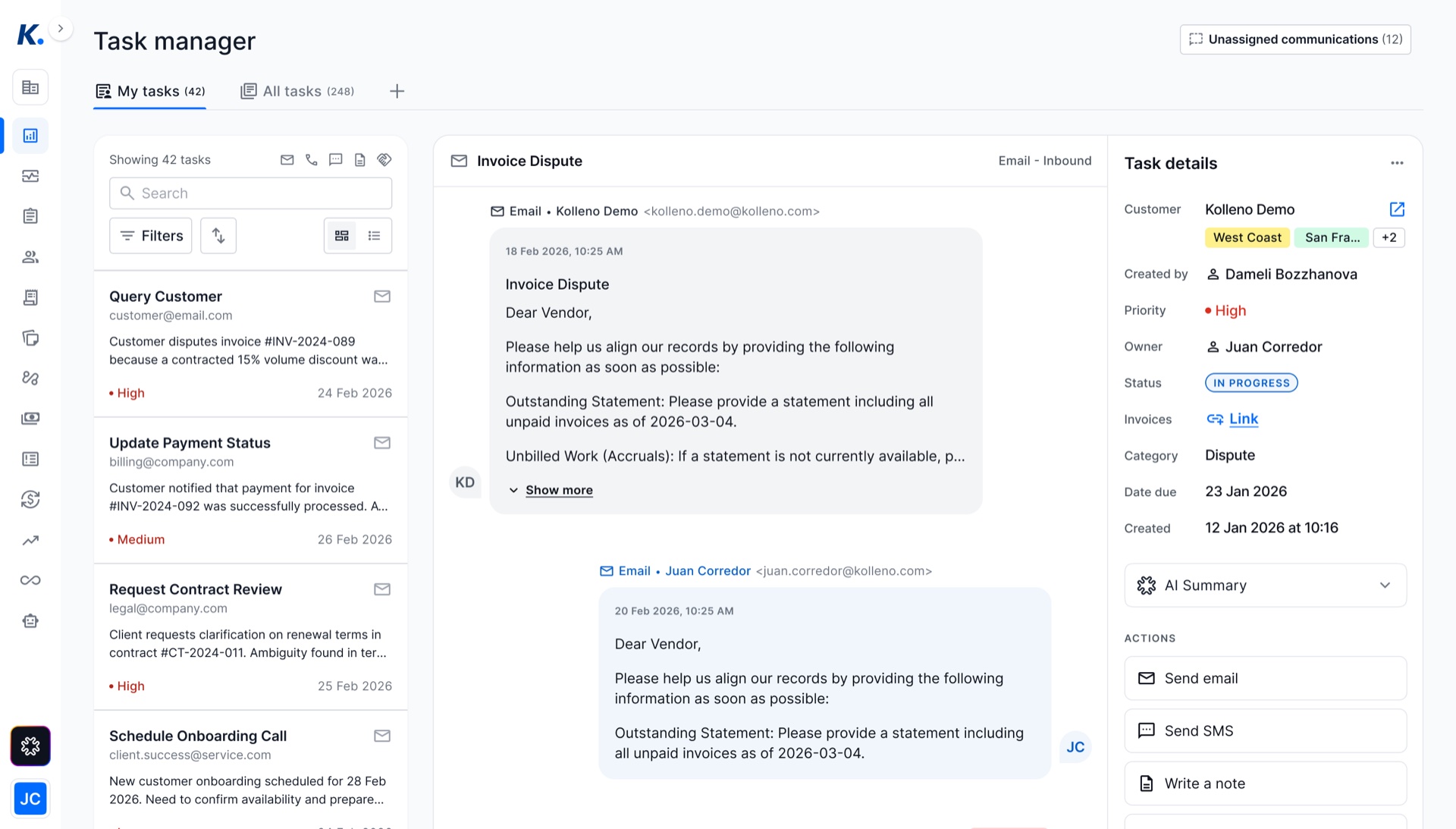
AI-powered agents can read and even interpret unstructured customer emails, draw live data from ERP systems, resolve disputes autonomously, and escalate complex cases with full context.
AI automates the following key functions:
- Cash Application: Automatically matches incoming wire, ACH, and lockbox payments to open invoices, reducing manual reconciliation and data entry.
- Collections and Outreach: Analyzes customer payment behavior, assesses collection risk, and sends personalized follow-ups.
- Dispute and Deduction Management: Identifies the reasons behind customer disputes and payment deductions, flags discrepancies, and routes cases to the appropriate teams for resolution.
- Credit and Risk Management: Assesses customer creditworthiness, monitors portfolio risk, and supports informed credit decisions.
Why Manual AR Processes Are No Longer Enough
AI agents in AR processes didn’t just pop up overnight. These tools were developed to overcome the challenges manual tools could no longer solve or keep up with. Here’s why manual AR processes are getting replaced with AI solutions.
Time-Consuming Processes
Manual AR processes require finance teams to handle repetitive administrative tasks across multiple systems, taking time away from more strategic activities.
For example:
- Invoice creation and distribution: Generating invoices, checking details, and sending them to customers.
- Payment monitoring: Checking bank accounts and payment records for incoming payments.
- Reconciliation: Matching payments against outstanding invoices.
- Data entry: Updating spreadsheets and accounting systems with payment statuses and customer information.
Inefficient Collections and Follow-ups
Manual collections make it difficult to prioritize overdue accounts and ensure timely follow-ups. Collectors may spend hours exporting ERP data to spreadsheets to identify which invoices need attention, rather than focusing on high-risk accounts. This can delay collection efforts, slow cash flow, and increase exposure to bad debt.
Limited Visibility into Outstanding Invoices
Static spreadsheets and disconnected systems make it difficult to maintain an accurate, real-time view of outstanding invoices. Payment updates, customer communications, and disputes are often scattered across different platforms, leaving collection teams with limited insight into why invoices are overdue, which accounts need attention, and the current state of cash flow.
Higher Risk of Human Error
Performing repetitive tasks with multi-step data entries is bound to lead to errors, from misapplying payments and duplicating or missing invoices to relying on incorrect spreadsheet calculations. Employees get tired or are rushed at times, so mistakes in ERP, spreadsheets, emails, and bank portals are statistically inevitable. Even a simple keystroke error can accidentally turn a $10,000 invoice into a $1,000 invoice or misallocate a payment to the wrong client.
Outdated payment records can also trigger unnecessary collection reminders, while misplaced documentation makes resolving customer disputes more difficult. These mistakes can disrupt cash flow, delay collections, and damage customer relationships.
Difficulty Scaling AR Operations
Manual AR processes are significantly harder to scale operationally because their capacity is tied directly to employee headcount. Usually, operational efficiency drops exponentially after invoice volume scales, forcing companies to hire more staff just to keep up with the administrative load.
The Key Benefits of AI in Accounts Receivable
AI takes accounts receivable from a reactive, administrative burden into a proactive, strategic driver of cash flow. It replaces spreadsheet tracking and time-consuming data entry with intelligent automation, accelerating time-to-cash.
Faster Payments and More Efficient Collections
By automating routine reminders and follow-ups based on customer responses and payment behavior, AI can reduce delays, shorten collection cycles, and lower DSO.
AI agents can analyze payment histories and risk profiles to prioritize accounts that need immediate attention. This allows you to focus efforts on where you are most likely to accelerate payment.
Improved Cash Flow Predictability
Use AI to analyze historical payment patterns, customer behavior, and real-time invoice data to estimate when outstanding payments are likely to arrive. It not only improves cash flow forecasting but also continuously monitors outstanding invoices, payment disputes, and customer promises to pay. You have a more up-to-date view of expected cash inflows, helping you anticipate cash shortages, plan expenses, and make more informed financial decisions.
Reduced Administrative Workloads
AI automates repetitive tasks such as payment matching, invoice reconciliation, and data entry, significantly reducing manual workloads. It can also validate invoices against purchase orders and historical customer data before they are sent, helping you identify errors early and reducing the time spent correcting billing issues.
Better Customer Relationships
AI can make collections more personalized, timely, and context-aware, which helps your business maintain positive customer relationships. It does this by tailoring payment reminders to each customer’s communication preferences and payment behavior. On top of that, AI can identify customers experiencing temporary financial difficulties so you can offer more flexible payment arrangements.
Live payment matching also reduces unnecessary follow-ups for invoices that have already been paid, creating a smoother customer experience and avoiding frustration.
Improved Decision-Making Through Data Insights
Use AI to analyze customer payment behavior, credit risk, and dispute trends for enhanced insights into your AR performance. Use it to flag emerging risks and monitor customer creditworthiness, helping you adjust credit terms before accounts become seriously overdue. By identifying recurring reasons for payment delays and disputes, AI also helps management uncover underlying operational issues and make better decisions.
How to Choose the Right AI-Powered AR Platform
While we’ve discussed the benefits of AI in accounts receivable, it’s important to recognize that not all AR platforms are built the same. Some are better suited to businesses with straightforward invoicing and payment collection needs, while others offer more advanced capabilities for managing complex, high-volume AR operations.
Therefore, it’s important to choose a platform that aligns with your business needs and goals, including automation requirements, integration capabilities, reporting needs, and scalability as your operations grow.
Here’s what to look for in an AI-powered AR platform:
Scalability and Ease of Use
A complex setup that requires internal IT teams to build extensive rules and hard-coded workflow templates will only take up time and money. Look for modern “agentic AI” platforms that deploy autonomously within weeks and run multi-step tasks in the background without user hand-holding.
Ensure customers can access a secure portal to view outstanding invoices, check account balances, manage payment methods, and make payments easily. This reduces payment friction, unnecessary queries, and manual follow-ups.
AI-Driven Collections and Prioritization
The ideal AR platform should provide dynamic risk scoring and predictive analytics that analyze historical invoice data, customer behavior trends, and payment probability to rank accounts by collection priority. This helps your team identify high-risk accounts, focus their efforts where they are most likely to accelerate payment, and address potential delays before they escalate. It also allows you to automate routine follow-ups while dedicating more time to complex accounts that require human intervention and more tailored collection strategies.
Automated Reminders and Customer Communications
Look for platforms that use behavioral analysis to adapt the tone, communication channel, and timing of payment reminders to each customer’s payment habits and preferences. This helps make outreach more relevant and increases the likelihood of a response or payment.
More advanced platforms also use generative AI or specialized AI agents to analyze incoming customer replies, identify intent (such as a dispute or promise to pay), and draft appropriate, context-specific responses. This reduces manual follow-ups while keeping customer communications timely and personalized.
Cash Application and Payment Reconciliation
Basic automation matches incoming payments to outstanding invoices using exact invoice numbers or clearly structured bank data, often requiring manual intervention when information is missing or inconsistent.
Prioritize platforms that use advanced machine learning and document recognition to interpret remittance information across multiple formats, including PDFs, check images, emails, and EDI files. These capabilities help identify payment references, match transactions to the correct invoices, and automate reconciliation with minimal manual intervention.
Integration with ERP and Accounting Systems
Before choosing an AR platform, check whether it offers pre-built integrations with your existing ERP and accounting software, such as NetSuite, Microsoft Dynamics 365, or QuickBooks. Prioritize bidirectional API synchronization that automatically updates invoice statuses, payment records, customer details, and account balances across both systems.
Also, confirm how frequently data syncs, whether integration requires additional development, and how the platform handles failed or duplicate data transfers. This helps avoid manual uploads, data inconsistencies, and costly implementation issues.
The Future of AI in Accounts Receivable
AR is shifting from software automation to autonomous, collaborative AI agents. The next generation of AR is likely to feature specialized AI agents capable of managing entire billing and collection cycles with minimal oversight.
At the same time, advances in AI will help you forecast cash flow more accurately, identify payment risks earlier, and ultimately help your finance team make proactive decisions.
Fully connected order-to-cash processes will increasingly connect invoicing, collections, payments, reconciliation, and customer communication into more integrated, intelligent workflows.
Transform Your AR and Order-to-Cash Cycle with Kolleno
Replace manual chaos with Kolleno’s AI-powered AR and order-to-cash automation platform. Our AI Agents handle complex collections and reconciliation
autonomously, so your finance team can focus on client relationships and strategy.
Kolleno’s Key AI-Powered AR Capabilities
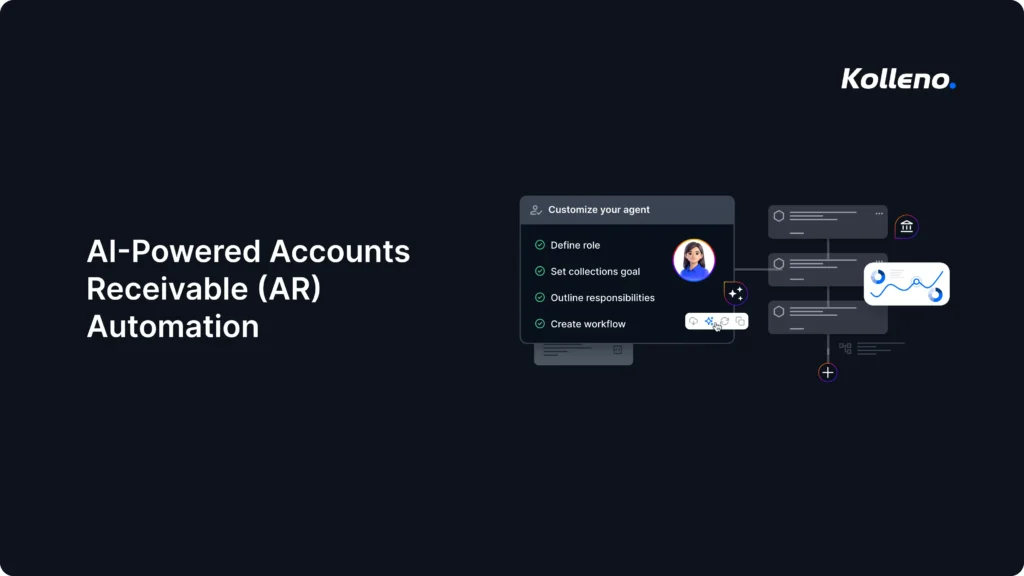
- AI Copilot and Agents (Maestro AI): Assists with collections, payment reconciliation, and other repetitive AR tasks.
- Intelligent Collections: Automates personalized payment reminders and follow-ups based on customer behavior.
- Predictive Analytics: Forecasts late payments, assesses credit risk, and prioritizes collection activities.
- Automated Cash Application: Matches incoming payments, including partial payments, to outstanding invoices.
- Dispute Management and Integrations: Centralizes dispute tracking and connects AR workflows with major ERP and accounting systems.
Ready to transform your AR and O2C processes with AI?
Frequently Asked Questions
Can AI-powered AR automation handle complex payment scenarios?
Yes. Advanced AR platforms can handle partial payments, bulk transactions, multiple invoices, credit notes, and payments with missing or inconsistent references. Unmatched transactions can be flagged for manual review.
Does AI-powered AR automation replace accounts receivable teams?
No. AI automates repetitive tasks such as payment matching, reminders, and account monitoring, allowing AR professionals to focus on complex disputes, customer relationships, and strategic decisions.
How can businesses measure the success of AI-powered AR automation?
Businesses can track metrics such as DSO, average collection time, overdue invoice rates, cash application accuracy, and the percentage of payments processed automatically.
When should a business consider AI-powered AR automation?
Businesses should consider AI-powered AR automation when manual processes start slowing collections, creating reconciliation backlogs, or limiting visibility into outstanding invoices. It’s particularly valuable for finance teams managing growing transaction volumes, multiple customer accounts, and increasingly complex payment workflows.
What does Kolleno automate in accounts receivable?
Kolleno brings collections, payment processing, cash application, dispute management, credit risk monitoring, and cash flow forecasting into one platform. Our AI agents help automate workflows across the order-to-cash cycle.
Can Kolleno integrate with existing ERP and accounting software?
Yes. Kolleno integrates with existing ERP, accounting, CRM, banking, and other business systems. Its integrations synchronize data between platforms, reducing manual data entry and keeping AR information up to date.
How much control do businesses have over Kolleno’s AI Agents?
Businesses can configure Kolleno’s AI Agents according to their credit policies and collection workflows. You can choose whether agents provide insights, act as copilots that prepare work for review, or execute tasks autonomously. They can also customize communication tones, languages, follow-up timing, and escalation rules.