


An aging accounts receivable report is one of the most useful documents in a finance team’s toolkit. It shows you not just what’s owed, but how long it’s been owed. That distinction matters because the longer an invoice sits unpaid, the lower the probability that it will ever be collected.
In this guide, we’ll cover:
- What accounts receivable aging means and why it matters
- How to create an AR aging report
- How to read and interpret the numbers
- Red flags to watch for in your aging data
- Strategies to reduce aged receivables
- GAAP compliance
What Is Accounts Receivable Aging?
Aging accounts receivable is the process of categorizing overdue invoices by how long they’ve been unpaid. Invoices are grouped into time-based buckets: current (not yet due), 1-30 days past due, 31-60 days past due, 61-90 days past due, and 91 or more days past due. The resulting report is called an accounts receivable aging report or an AR aging schedule.
The purpose is straightforward: to give finance teams a clear view of where collection risk is concentrated, so they can direct follow-up effort where it’s most needed. Total AR balance tells you what’s owed. The aging report tells you how worried you should be about it.
Why Accounts Receivable Aging Matters
The older a receivable gets, the less likely it is to be collected. Invoices that are current or slightly overdue are usually paid with a standard follow-up sequence. Invoices that are 90 days or more past due have a significantly lower recovery rate, and the cost of collecting them increases the longer they sit.
AR aging affects cash flow forecasting. If a large proportion of your receivables are concentrated in the older aging buckets, your actual cash conversion is lagging behind your revenue recognition. That gap creates working capital pressure and makes it harder to plan accurately.
Regular aging analysis also helps identify credit policy issues. A pattern of invoices moving into the 60+ day bucket from a specific customer segment, industry, or deal size suggests that credit is being extended to customers who don’t meet appropriate criteria, or that credit limits are set too high relative to payment history.
How to Create an Accounts Receivable Aging Report
To build an aging report, you need the following for each outstanding invoice:
- Customer name
- Invoice number
- Invoice date
- Due date
- Amount outstanding.
Most accounting and ERP systems store this data and can automatically generate aging reports. If you’re working in a spreadsheet, the same fields apply.
Standard Aging Buckets
The most widely used aging structure groups invoices as follows:
- Current: not yet due
- 1-30 days past due
- 31-60 days past due
- 61-90 days past due
- 91+ days past due
Some businesses use tighter buckets (0-15, 16-30) for high-volume invoice environments or extended buckets (120+, 180+) to distinguish between recoverable and potentially uncollectible accounts.
Example AR Aging Report
The table below shows a simplified aging report across three customers:
| Customer | Current | 1-30 Days | 31-60 Days | 61-90+ Days |
| Acme Corp | $12,000 | $4,500 | $0 | $0 |
| Beta Ltd | $0 | $8,200 | $3,100 | $1,800 |
| Gamma Inc | $22,500 | $0 | $0 | $9,000 |
In this example, Gamma Inc has $9,000 in the 61-90+ day bucket, which warrants immediate follow-up. Beta Ltd has $1,800 at the same stage, with additional amounts in the 1-30- and 31-60-day buckets, indicating a pattern of consistent late payment. Acme Corp has a healthy spread with nothing significantly overdue.
How to Read Your AR Aging Report
If 80% of your outstanding receivables are current or 1-30 days overdue, your AR health is reasonable. If 30% or more are in the 61-90+ day range, that’s a signal that your collection process or credit policy needs attention.
Look at both concentration and totals. A single customer representing the majority of your overdue balance is a different risk profile from a spread across many customers. High concentration in a slow-paying account creates both cash flow and credit risk.
There is no universal benchmark for a “good” AR aging percentage because it varies significantly across industries, payment terms, and customer types. The most useful comparison is against your own historical data: is the proportion in each age category improving or worsening over time?
Red Flags in Your AR Aging Report
Certain patterns in aging data deserve immediate attention.
- Sudden increases in a specific bucket: A jump in the 61-90 day bucket that wasn’t there last month indicates invoices are not being followed up on effectively, or that a specific customer or group of customers has stopped paying on their usual schedule.
- High concentration with a single customer: When one account represents a disproportionate share of your aged receivables, you have both a collection problem and a credit concentration risk that could damage cash flow if it becomes a write-off.
- Consistent slow payment from specific customers: If the same customers appear in the 31-60 day bucket every period, that’s a pattern, not an anomaly. It suggests the credit terms or credit limit you’ve extended are misaligned with their actual payment behavior.
- Data inconsistencies: Invoices appearing in multiple buckets, unexplained credits, or amounts that don’t reconcile with payment records indicate data quality issues that need to be resolved before the report can be trusted.
Strategies to Reduce Aged Accounts Receivables
Tighten Invoicing Discipline
Every day between delivery and invoice adds to your DSO before the payment clock even starts. Invoice promptly after delivery, with accurate information and clear payment instructions. Electronic invoicing with delivery confirmation provides a record of when the customer received the document.
Implement a Structured Follow-up Sequence
A pre-due-date reminder, a due-date notification, and a graduated escalation sequence after the due date will collect most invoices that are late due to oversight rather than intent. Consistency matters more than intensity. A predictable, professional follow-up sequence produces better results than sporadic, urgent contact.
Review and Tighten Your Credit Policy
If the same customers repeatedly appear in your older aging buckets, their credit terms may need to be adjusted. Shortening payment terms, reducing credit limits, or requiring upfront payment for high-risk accounts prevent future aging problems.
Offer Payment Flexibility
Customers who can’t pay the full invoice amount often pay nothing rather than making contact. Offering payment plans for genuinely struggling customers can help recover money that would otherwise become a write-off. Document any payment agreements formally.
Use AR Automation
Automated AR platforms apply follow-up sequences consistently across all accounts without relying on individual team members to remember to act. The result is faster collections, fewer invoices slipping into older buckets, and clearer visibility into where collection risk sits.
Accounts Receivable Aging and GAAP
Under generally accepted accounting principles (GAAP), businesses are required to estimate the portion of their accounts receivable that will not be collected and reflect this as an allowance for doubtful accounts on the balance sheet. The aging schedule is a common methodology for calculating this estimate.
Each aging bucket is assigned a historical collection rate, and the allowance is calculated by applying the expected uncollectible percentage to the outstanding balance in each bucket. As invoices age further, the expected loss rate increases.
This approach is consistent with GAAP’s matching principle, which requires that the cost of bad debt be recognized in the same period as the related revenue. Accurate aging data is therefore a financial reporting requirement, not just an operational convenience.
How Kolleno Supports AR Aging Management
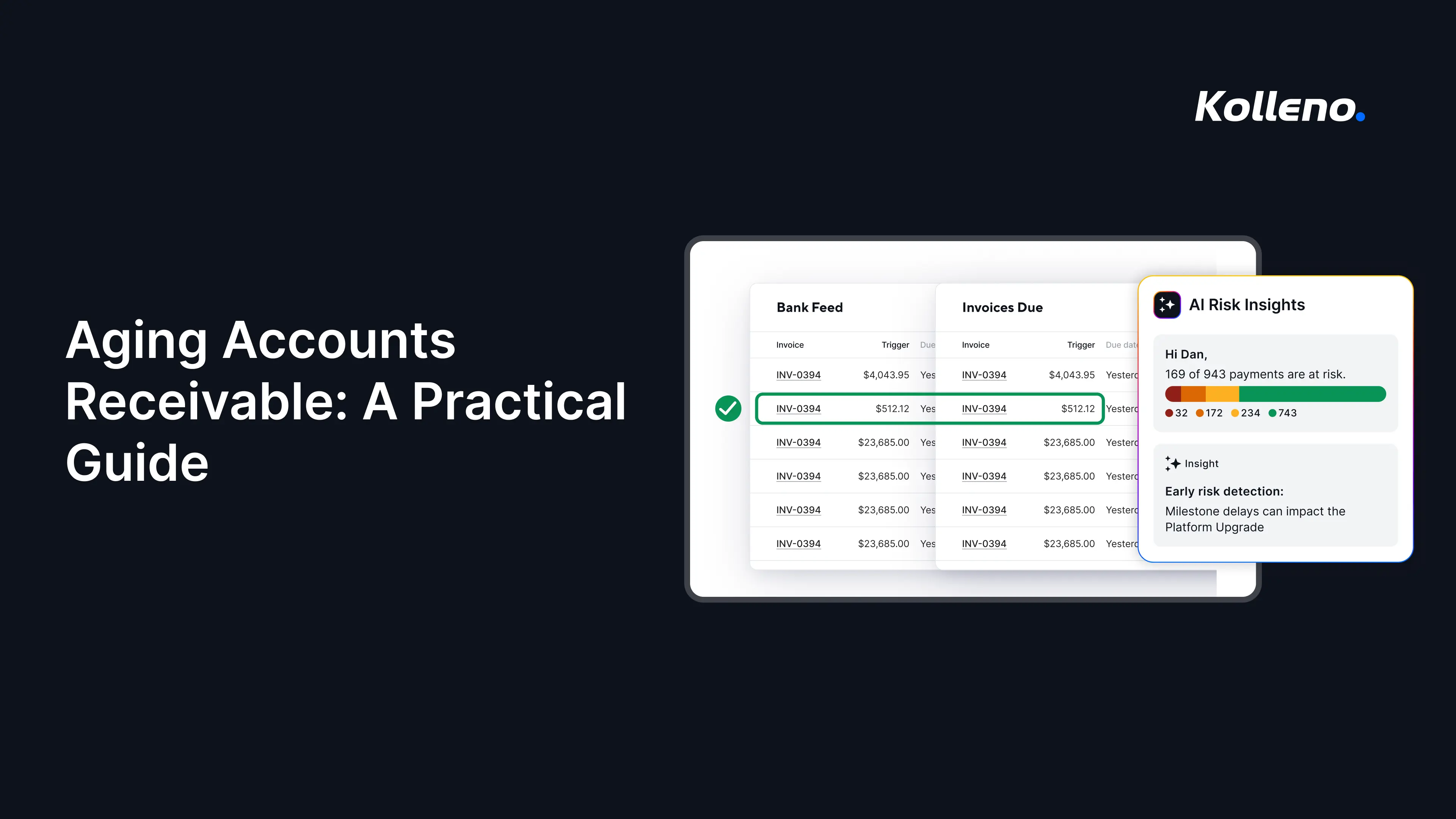
Kolleno’s O2C platform gives finance teams real-time visibility into AR aging across their entire customer base. AI Agents automatically apply follow-up tasks based on invoice age and account risk profile, ensuring that no invoice falls through the cracks. Credit risk monitoring flags accounts that are deteriorating before they become significant aging problems.
Finance teams define the rules. Kolleno’s platform executes them, surfaces exceptions that require human attention, and keeps aging data up to date without manual intervention.
Final Thoughts
An aging accounts receivable report is one of the most direct measures of your AR function’s effectiveness. Teams that review their aging data regularly, act on what it tells them, and use it to refine their credit policy and follow-ups repeatedly outperform those that treat it as a monthly formality.
If you want to see how Kolleno keeps aging data current and actionable across your full customer base, book a demo today.
Frequently Asked Questions
What does aging mean in accounts receivable?
Aging in accounts receivable refers to the practice of categorizing outstanding invoices by how long they have been unpaid. Invoices are grouped into time-based buckets, typically current, 1-30 days, 31-60 days, 61-90 days, and 91+ days past due. The resulting aging report helps finance teams identify overdue balances, prioritize collection efforts, and estimate bad debt risk.
Is accounts receivable aging required by GAAP?
GAAP requires businesses to estimate the amount of accounts receivable that will not be collected and record this as an allowance for doubtful accounts. The aging schedule is the standard method for making this estimate. Each aging bucket is assigned an expected loss rate based on historical collection experience. Accurate aging data is therefore a requirement for GAAP-compliant financial reporting.
What is a good accounts receivable aging percentage?
There is no single universal benchmark, as it varies by industry, payment terms, and customer profile. A healthy AR portfolio typically has the majority of outstanding balances in the current or 1-30-day buckets. A materially large share in the 61-90+ day range usually signals collection challenges, though the exact threshold depends on your industry and payment terms. Compare against your own historical trends for the most relevant context.
How do you calculate accounts receivable aging?
To calculate AR aging, group each outstanding invoice by the number of days it has been past due. Assign each invoice to the appropriate bucket: current, 1-30 days, 31-60 days, 61-90 days, or 91+ days past due. Sum the outstanding amounts within each bucket to produce the aging schedule. Most ERP and accounting systems generate this automatically from invoice and due date data.
- What Is Accounts Receivable Aging?
- Why Accounts Receivable Aging Matters
- How to Create an Accounts Receivable Aging Report
- How to Read Your AR Aging Report
- Red Flags in Your AR Aging Report
- Strategies to Reduce Aged Accounts Receivables
- Accounts Receivable Aging and GAAP
- How Kolleno Supports AR Aging Management
- Final Thoughts
- Frequently Asked Questions