


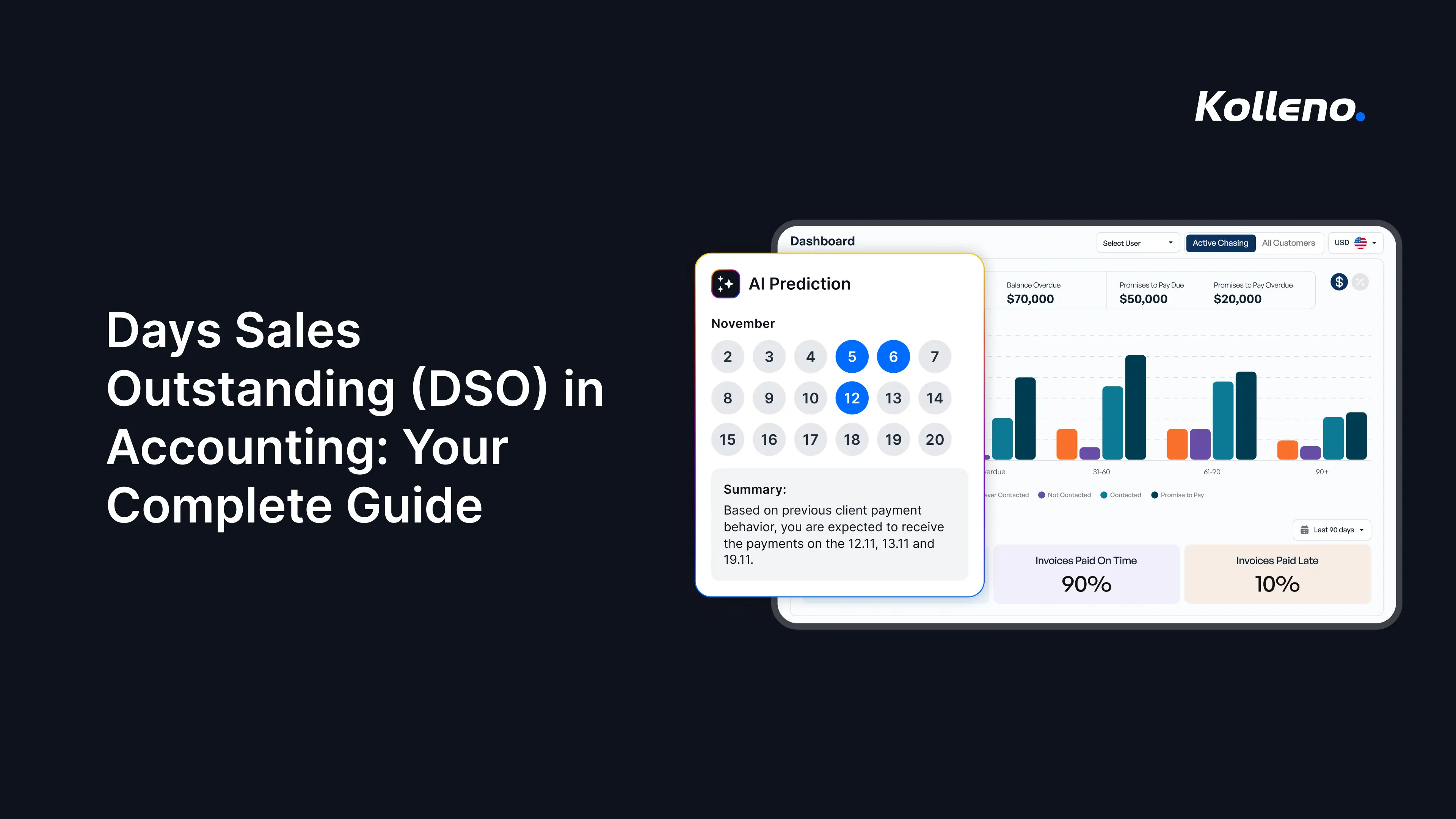
Your invoices look fine on paper, but cash still lands later than you’d like. Cash flow feels unpredictable, even though your team is on top of collections. That gap shows up in one number: your days sales outstanding (DSO).
DSO is one of the most telling metrics in a finance team’s toolkit because it shows how long, on average, it takes your business to convert a credit sale into cash. A high DSO signals slow collections. A low DSO signals an efficient accounts receivable (AR) process and healthy liquidity.
Understanding how to calculate DSO, interpret it correctly, and act on what it tells you is foundational to effective cash flow management.
In this guide, we’ll cover:
- What DSO means in accounting and how it fits into the cash conversion cycle
- How to calculate DSO accurately and choose the right inputs
- How to interpret DSO
- The internal and external factors that push DSO up or down
- Practical strategies to reduce DSO without damaging customer relationships
- How AR automation and Agentic Workflows help finance teams manage DSO proactively
What Is DSO in Accounting?
DSO is a financial metric that measures the average number of days it takes a company to collect payment after a sale has been made. It reflects both the terms your business extends to customers and how effectively your AR team collects against those terms. A DSO of 35 days means, on average, you’re waiting just over five weeks to receive payment after issuing an invoice.
DSO sits within the broader cash conversion cycle (CCC), which also includes Days Inventory Outstanding (DIO) and Days Payable Outstanding (DPO). Together, these three metrics describe how efficiently a business converts operational activity into cash.
Why Is Days Sales Outstanding Important for Your Business?
DSO is a direct indicator of cash flow health. A rising or higher DSO means cash is tied up in unpaid invoices for longer, which puts pressure on working capital. Businesses with high DSO often compensate with credit facilities or delayed supplier payments, both of which carry cost.
A declining or lower DSO, conversely, frees up cash that can be reinvested in operations, used to pay down debt, or retained as a liquidity buffer.
Beyond liquidity, DSO reflects the quality of your credit policy and the effectiveness of your collections process. If DSO is consistently higher than your payment terms, that’s a signal either that credit is being extended to customers who don’t pay on time, that your AR team is under-resourced, or that your invoicing process is creating delays that compound the collection problem.
DSO may also serve as an early warning indicator. A sudden increase in DSO can flag customer financial distress before a payment actually fails, giving your team time to respond proactively rather than react to a write-off.
The DSO Formula: How to Calculate Days Sales Outstanding
The standard DSO formula is:
DSO = (Accounts Receivable / Total Credit Sales) x Number of Days in the Period
Each component matters:
- Accounts Receivable is the outstanding balance owed by customers at the end of the period
- Total Credit Sales is the revenue generated through credit transactions during the same period
- Number of Days reflects the length of the period being measured, typically 30, 90, or 365 days
Example DSO Calculation
A business ends the quarter with $450,000 in accounts receivable. Total credit sales for the quarter were $1,500,000. The period is 90 days.
DSO = ($450,000 / $1,500,000) x 90 = 27 days
This means the business collects payment, on average, 27 days after a sale. If standard payment terms are net 30, this is a healthy result.
Some businesses calculate DSO using a rolling average of accounts receivable balances rather than the end-of-period balance, which smooths out the effect of end-of-month billing spikes.
Others use net sales rather than credit sales if cash sales represent an insignificant portion of revenue. The most important thing is consistency: whichever calculation method you choose, apply it consistently so that comparisons over time are valid.
Interpreting Your DSO: What Is a Good DSO Ratio?
There’s no universal answer to what constitutes a good DSO. Context determines everything. A DSO of 45 days is excellent for a construction firm where project-based billing and lengthy payment cycles are the industry norm. The same DSO at a SaaS company with net 30 terms would indicate a collections problem.
The most practical benchmark is to compare your DSO against your stated payment terms. If your terms are net 30 and your DSO is 55, your collections process has a 25-day gap that needs addressing.
Industry benchmarks provide additional context: financial data providers and industry associations publish average DSO figures by sector, and these can help you assess where you stand relative to peers.
Interpret DSO Value Within Your Business Context
A low DSO isn’t always positive in isolation. If your DSO drops sharply but sales are declining at the same rate, you may be looking at a shrinking customer base rather than improved collections. Interpret DSO in conjunction with revenue trends, customer concentration, and changes in payment terms.
Seasonal factors also affect DSO. Businesses with strong year-end or quarter-end sales spikes will often see DSO rise temporarily as a large volume of invoices enters the collections cycle simultaneously. Measuring DSO consistently across equivalent periods helps separate genuine performance signals from seasonal noise.
Key Factors Affecting Days Sales Outstanding
Internal factors are within your control:
- The rigor of your credit policy determines which customers you extend credit to and on what terms.
- Invoicing accuracy affects whether customers have a legitimate reason to delay payment.
- The speed and professionalism of your collections process determines how quickly you resolve overdue accounts.
- Internal team coordination between sales, operations, and finance affects whether invoices are issued promptly and disputes are resolved quickly.
External factors require monitoring rather than direct control. The economic environment affects customers’ ability to pay. Industry payment norms establish the baseline your customers compare your terms against. Customer financial health, particularly for concentrated accounts, creates exposure that can spike your DSO if a key customer enters financial difficulty. The competitive landscape can push you toward more generous credit terms to win business, with DSO implications that need to be managed actively.
Actionable Strategies to Improve and Reduce DSO
Reducing DSO requires working on multiple parts of the accounts receivable process simultaneously. The following strategies address the most common causes of extended collection cycles:
- Tighten your credit policy. Conduct credit assessments before extending terms to new customers. Review existing accounts periodically, particularly those with a pattern of late payment. Match credit limits and terms to the risk profile of each customer.
- Optimize your invoicing process. Invoice immediately when goods or services are delivered. Use electronic invoicing to reduce delivery time and ensure invoices reach the right contact. Double-check accuracy before sending: errors in invoice amounts or purchase order references are one of the most common reasons customers delay payment.
- Offer early payment incentives. A 1% or 2% discount for payment within 10 days (net 30 terms) is a low-cost way to accelerate cash collection. Not all customers will take it, but those with strong cash positions often will.
- Build a structured collections schedule. Don’t wait for invoices to become significantly overdue before following up. A pre-due reminder, an on-due-date notification, and a graduated escalation sequence within the first 15 to 30 days post-due significantly improves collection rates.
- Resolve disputes quickly. Disputes are one of the primary reasons for payment delay. Establish a clear internal process for escalating and resolving billing disputes, and track dispute resolution time as a metric in its own right.
- Review your aging AR report regularly. An aging report categorized by days overdue (0-30, 31-60, 61-90, 90+) gives your AR team a clear prioritization framework. Focus collection effort where the risk of non-payment is highest.
- Use AR automation technology. Automated collections platforms handle reminder sequencing, payment link delivery, response tracking, and reconciliation without manual intervention. They reduce the time between an invoice becoming overdue and the first follow-up action, which is often where the most time is lost.
DSO vs. Other Key Financial Metrics
DSO and DPO operate on opposite sides of the cash conversion equation. DSO measures how long it takes to collect from customers. DPO measures how long it takes to pay suppliers. A business with a high DPO and a low DSO collects cash before it pays it out, which is an advantageous cash flow position. Managing both metrics together gives you the most complete picture of your working capital cycle.
On the question of whether DSO and Average Collection Period (ACP) are the same: they are effectively equivalent. Both measure the average number of days to collect receivables. The difference is terminological rather than mathematical. DSO is more commonly used in operational finance and AR management contexts, while ACP appears more frequently in academic and financial analysis frameworks. The formula and the insight are the same.
DIO completes the cash conversion cycle picture by measuring how long inventory sits before it’s sold. For product businesses, DIO is a key driver of working capital efficiency alongside DSO and DPO.
How Kolleno Helps Reduce DSO in Practice
Reducing DSO is less about one-off campaigns and more about building a collections engine that runs consistently within policy. Kolleno is an AI-powered accounts receivable and order-to-cash platform that acts as an operational extension of your finance team, not just another system to maintain.
Kolleno’s multi-agent AI workforce executes Agentic Workflows across collections, payments, disputes, cash application, forecasting, and credit risk. Finance leaders define the objectives and credit policies; Maestro AI orchestrates task-specific agents to sequence reminders, prioritize at-risk accounts, and route escalations to the right people at the right time.
Because Kolleno connects directly to your ERP and accounting systems, DSO becomes a real-time operational metric rather than a month-end report. The platform shortens the gap between an invoice becoming due and the first follow-up, automates payment journeys, and speeds up cash application, giving you clearer cash flow visibility and more predictable DSO, while your team stays focused on strategy rather than manual execution.
Final Thoughts
Managing days sales outstanding is an ongoing discipline: policies, processes, and customer behavior all shift over time, and your DSO will reflect those changes long before they hit the cash balance. The finance teams that stay ahead are the ones that treat DSO as a live operational metric, not just a KPI to review after quarter-end.
If you want to see what Agentic Workflows and AR intelligence look like when they’re orchestrated across your entire order-to-cash cycle, book a demo and explore how Kolleno can help you reduce DSO while keeping humans in control of strategy.
Frequently Asked Questions
What is a good DSO ratio?
A good DSO sits close to or below your stated payment terms. If your terms are net 30, a DSO between 25 and 35 days is generally healthy. If DSO consistently exceeds your terms by more than 10 to 15 days, your collections process needs attention. Industry benchmarks vary significantly, so compare your DSO against sector peers as well as your own terms.
Is DSO the same as Average Collection Period (ACP)?
Yes. DSO and Average Collection Period describe the same metric: the average number of days it takes a company to collect payment after a sale. The formula is identical. DSO is the preferred term in operational finance and AR management, while ACP appears more often in academic finance and financial analysis contexts. Both can be calculated on a monthly, quarterly, or annual basis.
What is an example of a DSO calculation?
If a business has $600,000 in accounts receivable at the end of a 90-day quarter, with $2,400,000 in credit sales during that period, DSO = ($600,000 / $2,400,000) x 90 = 22.5 days. This means the business collects payment, on average, 22.5 days after issuing an invoice, which is ahead of most net 30 payment terms.
How can you improve your DSO?
Improving DSO requires attention to credit policy, invoicing speed, collections sequencing, and dispute resolution. Practical steps include tightening credit assessments for new customers, automating invoicing and payment reminders, offering early payment discounts, and using an AR automation platform to run structured dunning sequences. Reducing manual steps in the collections process is often the fastest route to meaningful DSO improvement.
Why does DSO matter for cash flow?
DSO directly determines how quickly revenue converts to cash. A DSO of 60 days means cash earned in January isn’t available until March. That gap creates working capital pressure that businesses typically bridge with credit facilities or delayed supplier payments. Reducing DSO by even 10 to 15 days can release significant cash, particularly for businesses with high invoice volumes or large average transaction values.
- What Is DSO in Accounting?
- Why Is Days Sales Outstanding Important for Your Business?
- The DSO Formula: How to Calculate Days Sales Outstanding
- Interpreting Your DSO: What Is a Good DSO Ratio?
- Key Factors Affecting Days Sales Outstanding
- Actionable Strategies to Improve and Reduce DSO
- DSO vs. Other Key Financial Metrics
- How Kolleno Helps Reduce DSO in Practice
- Final Thoughts
- Frequently Asked Questions