


Days Sales Outstanding (DSO) is one of the most closely watched financial metrics for a reason: it directly translates your accounts receivable position into a number that tells you how long it takes for cash to arrive.
For finance teams, every extra day is cash sitting idle rather than working. Finance leaders who track DSO consistently and act on it systematically will manage working capital better than those who review it once a quarter.
In this post, we’ll explore:
- Why DSO is one of the most important metrics to understand
- The DSO calculation
- How to interpret your DSO
- How finance teams can improve and manage DSO
What Is DSO in Finance and Why Is it an Important Metric?
DSO measures the average number of days it takes to collect payment after a credit sale. It quantifies the gap between invoicing and cash collection, expressed in days.
DSO sits at the intersection of your accounts receivable management, credit policy, and collections process. It’s a cash-flow metric, a collections-efficiency metric, and a credit-risk indicator all at once.
A high DSO ties up working capital, limits the cash available for payroll, investment, and operations, and increases the likelihood that aging receivables become bad debt. A low DSO frees up cash for reinvestment and gives leadership more accurate visibility into near-term liquidity.
Consistently low DSO indicates that a company’s credit and collections function is working as intended. Rising DSO, particularly when it outpaces revenue growth, signals potential issues with credit quality and collection effectiveness that require explanation.
DSO also plays a direct role in cash flow forecasting. If your DSO is predictably 42 days, your finance team can model cash receipts with confidence. If it’s volatile, forecast accuracy suffers, and the business carries a higher-than-necessary precautionary cash buffer.
How to Calculate Days Sales Outstanding
The Standard DSO Formula (Simple Method)
DSO = (Accounts Receivable / Total Credit Sales) x Number of Days in Period
To calculate DSO for a quarter, take your accounts receivable balance at the end of the quarter, divide it by your total credit sales for that quarter, and multiply by the number of days in the period (typically 90 for a quarter, 365 for a year).
For example, a company ends Q1 with $750,000 in accounts receivable. Total credit sales for the quarter were $1,500,000. The period is 90 days.
- DSO = ($750,000 / $1,500,000) x 90
- DSO = 0.5 x 90 = 45 days
This means the company is taking an average of 45 days to collect its receivables in Q1.
The Countback Method
The countback method is used when sales are uneven over the period, making the simple method less accurate. Instead of dividing total credit sales into the AR balance, you work backward from the end of the period, subtracting each month’s sales from the AR balance until it reaches zero.
The number of days counted represents DSO. This method is more precise for businesses with significant seasonal variation but requires more granular data to apply correctly.
What Is a Good DSO?
There’s no universal answer. DSO interpretation is always relative. The most useful reference points are your own payment terms and your industry peers.
If your standard terms are Net 30, a DSO of 35-40 days indicates that most customers are paying on or slightly past the agreed date, which is typical. A DSO of 65 days on Net 30 terms often signals that collections are underperforming.
Industry norms vary considerably. Retail and hospitality businesses, where payment cycles are short, often carry DSO below 30 days. Construction, professional services, and enterprise software businesses routinely operate with DSO of 60 days or more, reflecting the longer contract terms and approval chains common in those sectors.
Benchmark your DSO against businesses in your specific category, not against a generic target.
Factors That Affect DSO
Several variables move DSO independently of how well your team is collecting:
- Credit terms: Net 60 terms set a higher DSO floor than Net 30
- Invoicing accuracy: Billing disputes caused by errors delay payment
- Customer payment behavior: some customer segments pay more slowly by habit or by policy
- Seasonality: end-of-quarter sales spikes can temporarily inflate DSO
- Economic conditions: economic pressure on your customers lengthens their payment cycles
Understanding which factor is driving a change in DSO determines the right response. Tightening credit terms won’t help if the problem is invoicing errors. And faster dunning cadences won’t move the needle if customers are operating under Net 60 terms you’ve already agreed to.
Actionable Strategies for Improving and Managing DSO
Set Clear Payment Terms and Display Them Consistently
Your terms should appear on every invoice, every contract, and every customer communication. Ambiguity about when payment is due creates preventable delays.
Review your standard terms regularly and consider whether they’re aligned with both your cash flow needs and your competitive environment.
Send Invoices Immediately and Accurately
Every day between delivery and invoicing adds to DSO before the clock even starts.
Automating invoice generation removes this delay entirely. Accuracy also matters: a single billing error that triggers a dispute can add 30 or more days to the collection cycle on that receivable.
Implement a Structured Dunning Cadence
Consistent, automated payment reminders that are timed to invoice age will shorten collection cycles without requiring your team to manually track every open receivable.
Segment your customers by payment history so that your highest-risk accounts receive earlier and more persistent outreach, while reliable payers receive lighter-touch reminders.
Leverage Technology and Automation
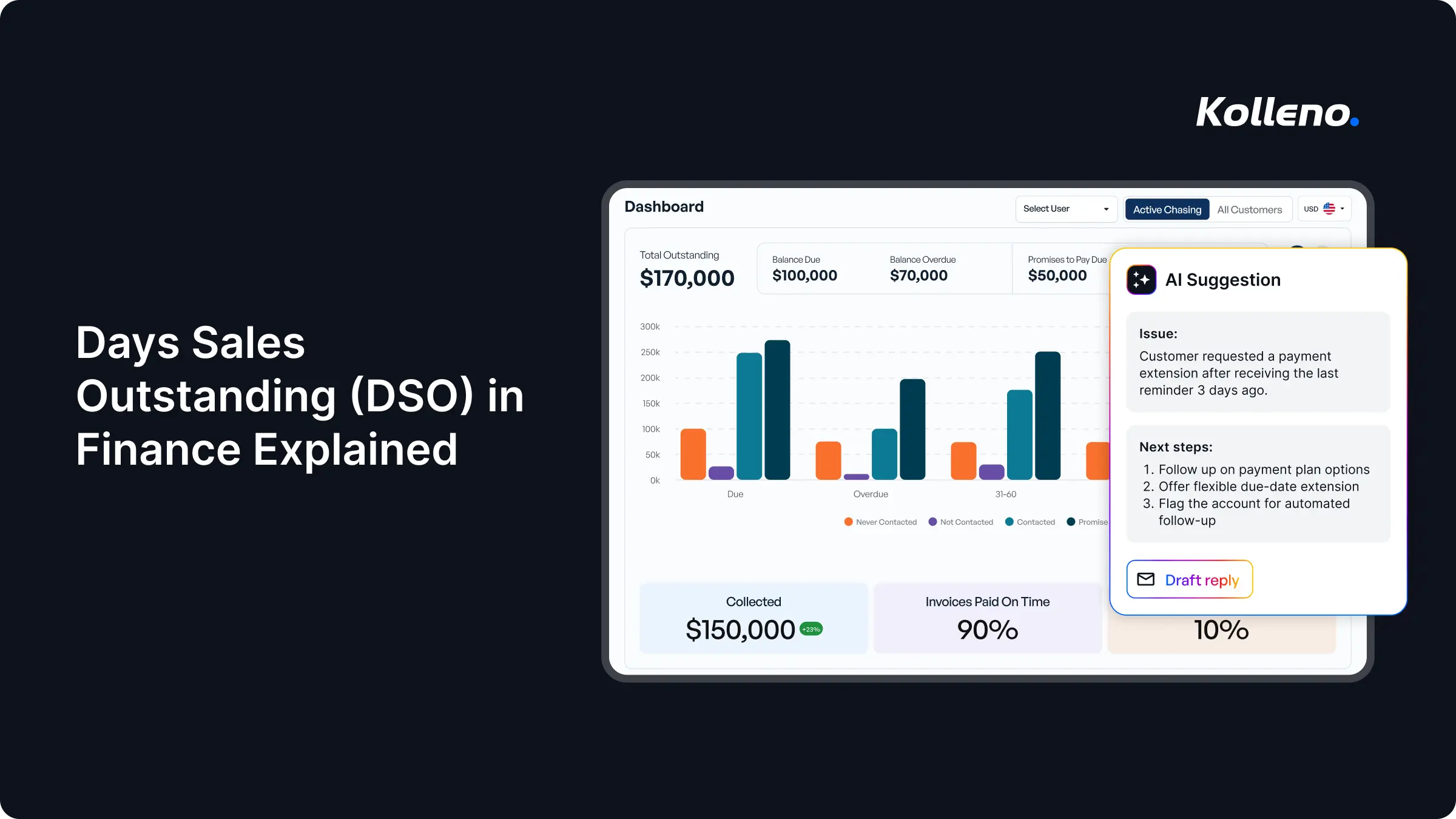
Finance teams that still manage AR through manual processes face a structural disadvantage. AR automation platforms consolidate invoicing, payment collection, cash application, and collections workflow into a single system.
Predictive analytics within these platforms can identify customers showing early signs of payment delay, allowing proactive outreach before invoices go past due rather than reactive follow-up afterward.
Align Sales and Finance on DSO
Sales teams that understand DSO and its relationship to cash flow make better credit decisions. Including DSO as a metric in cross-functional performance reporting encourages the sales function to consider payment terms, customer creditworthiness, and invoice accuracy as shared responsibilities rather than purely finance concerns.
Track Your DSO for Continuous Improvement
Finance teams with strong AR management review DSO weekly, track it by customer segment and product line, and set internal targets that are tighter than the industry benchmark they’re working toward.
Accounting and ERP platforms, including NetSuite, QuickBooks, Xero, and Microsoft Dynamics, all generate AR aging reports and DSO dashboards that can be configured to send automated alerts when individual customer DSO exceeds a defined threshold.
Integrating your accounting system with your CRM allows the sales team to view payment status in real time, improving the quality of customer conversations and accelerating issue resolution.
DSO Is Not the Same as Collections
DSO is a metric that measures the speed of cash collection. Collections are the set of activities, reminders, calls, escalations, and negotiations that drive the speed.
A business can have a well-structured collections activity and still carry a high DSO if its credit terms are long. Conversely, a business with short credit terms but poor dunning discipline might show a reduced DSO figure while leaving significant recoverable cash uncollected.
Use DSO as your measurement tool and collection effectiveness as your performance indicator.
Final Thoughts
Days Sales Outstanding is one of the clearest signals of how efficiently your order-to-cash process is working. Used alongside AR aging, turnover ratios, and collection metrics, it helps finance teams spot problems early, align credit and sales decisions, and forecast cash more reliably. The key is not just tracking DSO, but acting on the drivers behind it.
Kolleno’s O2C platform provides finance teams with AI-driven collections management and full visibility across the receivables portfolio, enabling them to orchestrate their AR strategy rather than react to it. If you want to see what this looks like in practice, book a demo.
Frequently Asked Questions
Is it good to have a low DSO?
Generally yes. A lower DSO means you’re collecting cash faster, which improves liquidity and reduces bad debt exposure. However, it can occasionally indicate that credit terms are more restrictive than necessary, potentially limiting sales. The goal is a DSO that reflects efficient collection and financial health within terms that support business growth.
What is the difference between the simple method and the countback method for calculating DSO?
The simple method divides your AR balance by total credit sales for the period and multiplies by the number of days. It’s straightforward but can be distorted by uneven sales patterns.
The countback method sequentially subtracts each month’s sales from the AR balance, counting days until the balance reaches zero. It’s more accurate for businesses with significant seasonal variation.
What factors impact days sales outstanding?
DSO is influenced by credit terms, invoicing speed and accuracy, customer payment behavior, seasonality in sales, and broader economic conditions.
Changes to any of these will affect DSO regardless of how your collections team is performing. Identifying which factor is driving a change is essential before deciding on a response.
What is the average DSO by industry?
Retail and hospitality tend to operate on a 30-day cycle. Professional services, construction, and enterprise software businesses often carry a DSO of 60 days or more.
These figures shift with economic conditions and should be used as directional guidance rather than precise targets. Compare against verified industry data from your sector’s trade bodies or financial research providers.
- What Is DSO in Finance and Why Is it an Important Metric?
- How to Calculate Days Sales Outstanding
- What Is a Good DSO?
- Factors That Affect DSO
- Actionable Strategies for Improving and Managing DSO
- Track Your DSO for Continuous Improvement
- DSO Is Not the Same as Collections
- Final Thoughts
- Frequently Asked Questions