

If you’re a mid-market or enterprise business struggling to match incoming payments with invoices accurately and efficiently, payment reconciliation software can help streamline the process. Its automation capabilities help you reduce manual work, improve accuracy, and gain faster visibility into cash flow.
In this article, we’ll discuss:
- What payment matching software is: How it works and why it’s become essential for modern finance teams.
- The key benefits: How it improves accuracy, speeds up the process, reduces costs, and strengthens financial control.
- The role of AI: How AI automates matching, handles exceptions, and continuously improves accuracy.
- The features to look for: The capabilities, integrations, and automation tools that deliver efficient end-to-end payment matching.
- How to choose the right solution: The factors to consider when evaluating software for your business’s current and future needs.
[Also read: Accounts receivable automation guide]
Understanding Payment Reconciliation Software
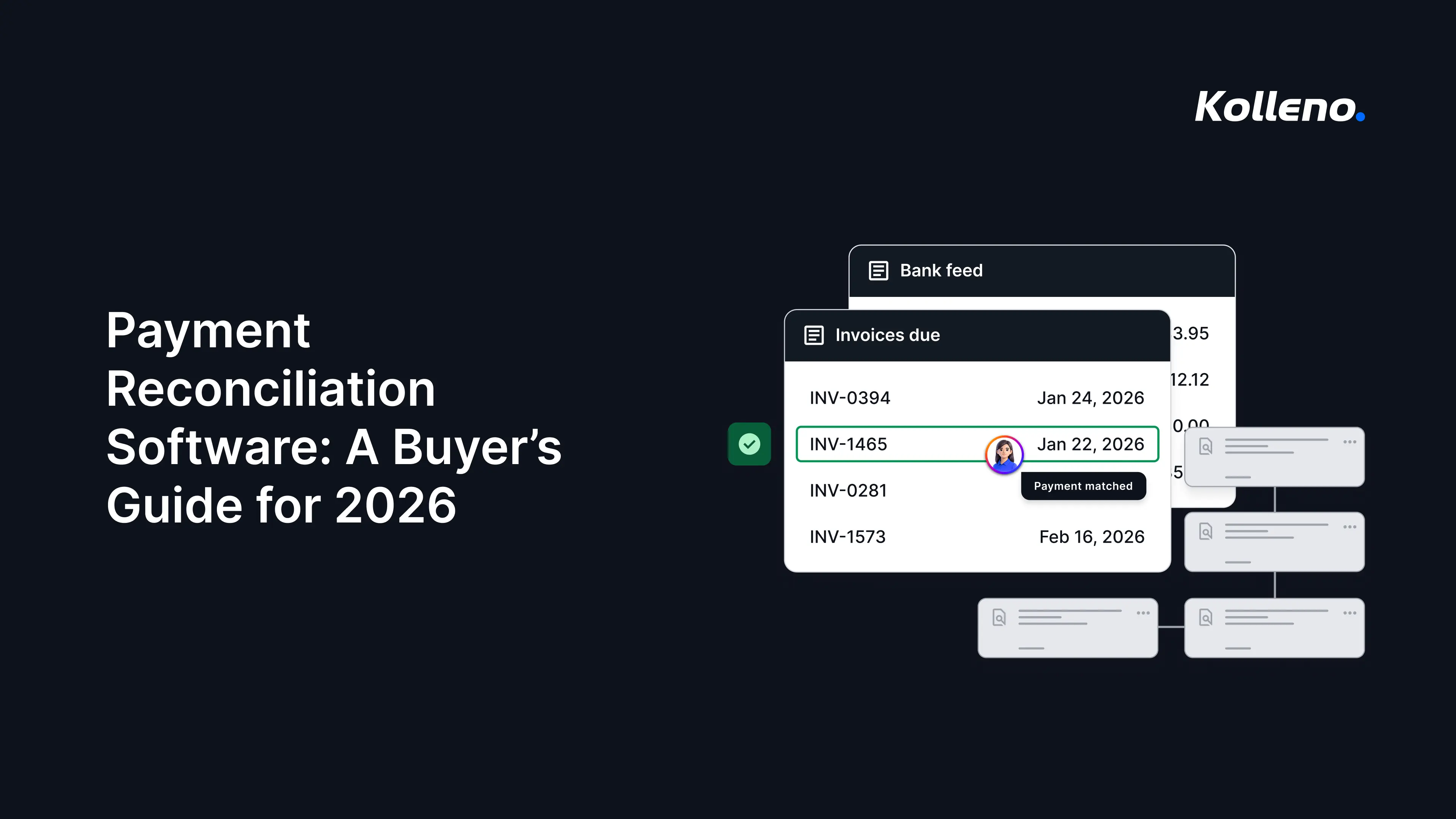
Payment reconciliation is a solution that automatically matches incoming and outgoing payments with the corresponding invoices, bank transactions, and accounting records. The software consolidates financial information into a single workflow, allowing you to identify matching transactions and flag any discrepancies that require review.
How Does Payment Matching Work?
The exact workflows may vary between providers, but most payment reconciliation software follows the same core process:
- Collect transaction data from banks, payment gateways, ERP systems, and accounting platforms.
- Compare payments against invoices, customer accounts, and general ledger entries.
- Automatically match transactions using predefined rules and intelligent matching logic.
- Flag exceptions, missing payments, duplicate transactions, or other discrepancies for review.
- Update financial records once transactions have been successfully reconciled.
Why Manual Payment Matching Falls Short
Relying on manual financial processes at scale is not only slow but also prone to human error. According to the Institute of Finance & Management (IOFM), manual invoice data entry has an average error rate of approximately 3.6%. And errors are something you can’t afford.
For example, a single missing reference number, duplicate payment, or incorrectly applied transaction can create discrepancies that take hours to resolve. These issues delay financial reporting, reduce cash flow visibility, and pull finance professionals away from more strategic work.
These challenges become even more pronounced for mid-market and enterprise organizations handling thousands of transactions across multiple currencies, payment methods, and business entities.
Why Payment Reconciliation Software Matters
Traditional payment matching is still a time-consuming, manual process for many finance teams because financial data is fragmented across mismatched systems, and source files constantly change formats. Every day, you need to match invoices with incoming payments across banks, payment gateways, ERP systems, and accounting platforms. And with growing transaction volumes, this quickly turns into hours of searching through spreadsheets, comparing records, and investigating mismatches.
This is where payment reconciliation software makes a significant difference. With automation and AI, matching workflows become faster, more intelligent, and significantly less dependent on manual intervention. This improves transaction matching speed and accuracy.
Key Benefits: Driving Efficiency and Financial Control
Payment reconciliation software is more than just automating transaction matching. It helps your finance teams work faster and make better decisions while reducing risks. When processing hundreds or thousands of transactions each month, it creates efficiencies that are difficult to achieve with manual processes alone. Here’s a closer look at the core benefits.
Accelerate the Month-End Close
If you’re already dreading the next month-end close, payment reconciliation software can help ease your worries. Instead of verifying thousands of transactions before financial statements can be finalized at the end of the month, transactions are matched automatically as they occur. This means you or your finance team spend less time searching for missing payments or correcting mismatches and more time reviewing genuine exceptions.
For example, a retailer can enter month-end with the majority of transactions already reconciled. This significantly reduces close times, instead of spending several days reconciling payments from multiple bank accounts and payment providers.
Improve Accuracy Without Increasing Workloads
Sometimes, even the most experienced finance professionals make mistakes when manually reconciling large volumes of data. Duplicate entries, incorrect payment references, and missed invoices can create discrepancies that delay reporting and require additional investigation.
Payment reconciliation software applies the same matching rules consistently across every transaction. It reduces the likelihood of human error while creating a clear audit trail for every automated matching decision. Also, your business can process significantly more payments without proportionally increasing headcount as your business grows.
Gain Better Cash Flow Visibility
If you’re a finance leader, you’d want a clear picture of available cash and outstanding customer payments. That’s what accurate exception handling enables. Imagine a manufacturer receiving payments through bank transfers, card payments, and online payment providers. Without reconciliation, you may struggle to determine which invoices have been paid.
In short, automated matching continuously updates payment statuses. It gives your finance team more reliable information for forecasting, collections, and working capital planning.
Enable More Strategic Financial Management
One of the biggest benefits of payment reconciliation software is changing how finance teams spend time. They can replace tedious tasks such as manually comparing spreadsheets or chasing payment discrepancies with more strategic financial management. Whether you want to focus on forecasting, analyze payment trends, or identify collection risks, all of these tasks allow you to support business decisions with more accurate financial data.
[Also read: Accounts Receivable Management Guide]
The AI Advantage in Modern Reconciliation
It’s no surprise that automation has rewired how accounting firms execute payment matching. For years, finance teams were able to create predefined matching rules, for example, matching transactions by invoice number, payment amount, or customer reference.
While this was a major improvement over manual payment matching, it still had limitations. Any transaction that didn’t follow those rules usually required someone to step in and resolve it manually.
Enter AI-powered platforms.
AI Adds Another Layer of Problem-Solving
Using machine learning reconciliation techniques, these platforms can recognize patterns across historical transactions and improve matching accuracy over time. This allows the software to handle the kinds of payment scenarios that regularly challenge finance teams.
For example, AI can identify relationships between:
- A single customer payment that settles multiple invoices.
- Multiple partial payments made over several days.
- Payments that include deductions for discounts, fees, or credit notes.
- Transactions with missing or inconsistent payment references.
- Remittance advice received as PDFs or emails instead of structured data.
To sum it up, AI-powered platforms can analyze the available information, determine the most likely match, present your team with a recommendation, or reconcile payments automatically when confidence is high.
AI Continuously Improves and Evolves
If a finance professional corrects a match or resolves an exception, the platform learns from that decision. Then, it applies similar logic when comparable transactions appear in the future. As transaction volumes increase, the matching process becomes more efficient without requiring finance teams to rewrite matching rules whenever business processes change.
The next step in this evolution is agentic AI. These are autonomous AI systems that actively plan, make decisions, and execute multi-step processes with minimal supervision. This technology does more than simply assist with individual matching decisions.
Agentic AI can autonomously:
- Manage larger parts of the financial matching workflow.
- Monitor incoming transactions.
- Prioritize exceptions.
- Request additional information when needed.
- Complete routine financial matching tasks.
And, it does all this while still keeping you in control of approvals and oversight.
What This Means for Modern Accounting Firms
The AI shift allows automation to extend beyond transaction matching. You won’t have to spend hours reviewing exceptions anymore. Instead, you can focus on investigating genuinely unusual cases and improving cash flow strategies while supporting broader financial planning.
As AI capabilities continue to evolve, matching processes become faster and more accurate but also increasingly intelligent and adaptable to the way today’s businesses operate. Deloitte found that 87% of CFOs expect AI to be very important to their finance department’s operations, highlighting the growing role of AI-driven automation in current finance.
Platforms such as Kolleno build on these AI capabilities by combining intelligent reconciliation with accounts receivable automation, giving you a unified way to manage payments, collections, and cash applications.
Essential Features of Top Reconciliation Platforms
No two platforms offer the same features. It’s wise to look for one that is suitable for your business needs and goals.
When comparing providers, these are the features worth prioritizing:
Intelligent Transaction Matching
The primary purpose of payment matching software is to match transactions accurately and efficiently, so this should be your first evaluation criterion. For example, let’s say a customer combines payments for several invoices into one bank transfer or pays an invoice in multiple installments. In that case, the platform should reconcile these scenarios without forcing your finance team to manually piece the transactions together.
As such, look for a provider that supports:
- Flexible transaction matching rules based on invoice numbers, payment references, customer details, dates, and payment amounts.
- One-to-one, one-to-many, and many-to-many matching scenarios.
- Automatic identification and management of exceptions.
- AI-assisted matching that improves accuracy over time.
- Manual review workflows for transactions that require manual approval.
Deep ERP and Financial System Integration
A platform that cannot exchange data seamlessly with your existing finance technology will only create additional work. It creates data silos, limits scalability, increases manual error risks, and even delays financial close, among other operational hiccups.
As a result, the ideal provider should offer resilient integration with the ERP systems and accounting software you already use, such as NetSuite, Oracle, SAP, Microsoft Dynamics 365, Xero, or QuickBooks. Ideally, integrations should be secure, with two-way synchronization so payment information, invoices, customer records, and payment verification statuses remain consistent across systems. This reduces duplicate data entry and ensures everyone works from the same financial information.
Reporting, Controls, and Financial Visibility
Other than matching payments, reconciliation should also support stronger governance, compliance, and financial decision-making. A good platform provides:
- Customizable dashboards showing reconciliation status and outstanding exceptions.
- A complete audit trail documenting every automated match, manual adjustment, and approval.
- Performance metrics that help identify recurring transaction matching issues.
- Reporting that supports month-end close and the automated matching of balance sheet accounts.
- Exportable reports for auditors and internal finance reviews.
The above features make it easier for your company to demonstrate compliance, investigate discrepancies, and monitor how efficiently matching processes are performing over time.
How to Choose the Right Reconciliation Software
Choosing the right software is about more than comparing feature lists. The best solution should fit your current finance processes while giving you the flexibility to scale as your business grows. Here’s what you can do to make your choice easier:
Assess Your Reconciliation Needs
Before you do anything, first understand your current matching process. This gives you a better idea of what you need from your ideal match. Consider:
- Monthly transaction volumes.
- The number of bank accounts and payment providers.
- Multiple currencies or legal entities.
- Common reconciliation challenges, such as partial payments or disputes.
- Existing ERP and accounting systems.
Keep in mind that a solution designed for a business processing a few hundred payments each month may struggle to support an enterprise reconciling thousands of transactions.
Compare Pricing Models
Providers use different pricing models, so it’s essential to choose one that aligns with your budget while covering all your needs. They typically offer:
- Per-user subscriptions.
- Transaction-based pricing.
- Tiered plans based on features or transaction volumes.
- Custom enterprise pricing.
A good tip is to not focus solely on software costs but to consider the overall value the platform delivers. This gives you a good scope of how much you’ll likely spend and if the features and capabilities offered by the provider are worth your money.
Calculate the ROI
To continue on the previous point, consider if the return on investment extends beyond labor savings. Check if the platform can help:
- Reduce manual payment matching time.
- Shorten the month-end close.
- Improve matching process accuracy.
- Increase cash flow visibility.
- Enable your finance team to focus on higher-value work.
These operational improvements often deliver greater long-term value than the subscription cost alone.
Tip: Use our ROI calculator to help with this step.
Evaluate Implementation and Support
Finally, look beyond the product itself and ask how long implementation typically takes. Whether integrations are included, what onboarding resources are available, and what level of customer support is provided after deployment.
The right platform should not only solve today’s financial matching challenges but also support your finance team as your business, transaction volumes, and operational complexity continue to grow.
Comparing Leading Payment Reconciliation Solutions
The payment reconciliation market offers a wide range of solutions, from enterprise financial close platforms to AI-first finance automation software. Ultimately, the right choice depends on your transaction volumes, existing finance systems, and the level of automation your team requires.
That said, it’s best practice to evaluate the current market so you can be well-informed on the top available options.
Enterprise Financial Close Platforms
Solutions such as BlackLine and HighRadius are designed for large enterprises with complex financial operations. They typically offer broad capabilities that extend beyond payment matching, including financial close management, account reconciliations, compliance, and financial controls.
These platforms are often well suited to organizations with highly structured finance teams, multiple business entities, and complex governance requirements.
AI-Driven Finance Automation
As we’ve discussed, newer platforms are using AI to reduce manual intervention throughout the reconciliation process.
For example, Numeric applies AI to financial close workflows. Meanwhile, other modern platforms increasingly use machine learning to improve transaction matching, identify anomalies, and resolve exceptions with minimal manual effort.
This approach is particularly valuable for organizations experiencing fast transaction growth or looking to reduce repetitive finance tasks.
Integrated Accounts Receivable Platforms
Some organizations need more than standalone finance automation software. They want a platform that connects reconciliation with invoicing, collections, cash application, and customer payments.
For example, Kolleno combines AI-powered transaction matching with accounts receivable automation in a single solution. You can automate transaction matching while also managing collections, customer communications, payment processing, and cash application from one place.
For businesses looking to improve cash flow, reduce manual work, and simplify finance operations, this integrated and convenient approach can remove the need to manage multiple disconnected tools.
Which Platform Is Right for You?
The best solution depends on your business needs.
- Large enterprises with extensive financial close and compliance requirements may prioritize platforms like BlackLine or HighRadius.
- Finance teams focused on AI-enabled close processes may evaluate solutions such as Numeric.
- Mid-market and enterprise organizations looking to automate payment matching while modernizing their broader accounts receivable processes may benefit from an integrated AI-powered platform like Kolleno.
Conclusion: Automate Reconciliation for Strategic Growth
Today’s payment reconciliation software helps finance teams automate repetitive processes, improve accuracy, and gain better visibility into cash flow while supporting a faster financial close.
More importantly, it allows you to spend less time resolving routine discrepancies and more time contributing to forecasting, financial planning, and business performance. Whether you’re evaluating your first payment matching platform or replacing an existing solution, choosing software that combines automation, AI, and seamless integrations can help create a more efficient and scalable finance function.
Kolleno: Where Human Expertise Meets AI Execution
Built around the philosophy of human expertise and AI execution, Kolleno combines intelligent automation with finance oversight. Our AI agents can automate repetitive processes across payment matching, collections management, cash application, and customer communications, while keeping you in control of approvals and exceptions.
The aim is not to replace finance professionals but to help you spend less time matching transactions or chasing payments. Kolleno gives you more time to improve cash flow, support business decisions, and strengthen customer relationships.
Whether you’re looking to optimize payment reconciliation or streamline your wider order-to-cash workflow, Kolleno provides a single finance automation platform designed to reduce manual work without adding unnecessary complexity.
Ready to see how AI-powered payment reconciliation can transform your finance operations? Get in touch with the Kolleno team to book a personalized demo.
Request a Demo Contact Us Today
Frequently Asked Questions
Can payment reconciliation software handle partial or split payments?
Yes. Most modern platforms can reconcile one-to-many and many-to-many payment scenarios, such as customers paying multiple invoices in a single transaction or settling an invoice through several installments. AI-powered solutions can also identify likely matches when payment references are incomplete or inconsistent.
How long does it take to implement payment reconciliation software?
Implementation depends on the complexity of your finance environment. Businesses using standard ERP or accounting integrations can often be up and running within weeks, while larger enterprises with multiple entities, payment providers, and custom workflows may require a longer rollout.
Can reconciliation software work with multiple banks and payment providers?
Most enterprise platforms support integrations with multiple banks, payment gateways, and payment methods. This enables you to reconcile transactions from different sources within a single workflow instead of switching between multiple systems.
How does AI improve payment matching accuracy?
AI goes beyond predefined matching rules by recognizing payment patterns, learning from previous reconciliation decisions, and analyzing unstructured remittance information. This helps reduce manual reviews and improves matching accuracy over time.
Is payment reconciliation software suitable for businesses with low transaction volumes?
It can be, but the greatest return on investment is typically seen by organizations processing large transaction volumes or managing multiple payment channels. For smaller businesses, the decision often depends on growth plans, reconciliation complexity, and the amount of time currently spent on manual processes.
What should I ask vendors during a software demonstration?
Ask vendors how they handle complex matching scenarios, what ERP and banking integrations they support, how exceptions are managed, what AI capabilities are included, how reporting works, and what implementation and ongoing support look like. Understanding these areas will help you compare platforms beyond feature lists.
Does payment reconciliation software replace cash application?
Not necessarily. Payment reconciliation focuses on matching financial transactions and identifying discrepancies, while cash application applies customer payments to the correct invoices. Many finance platforms today combine both capabilities to streamline the wider order-to-cash process.
How can I measure the success of a reconciliation project?
Useful metrics include reconciliation rates, time spent on manual matching, exception volumes, month-end close times, and the number of transactions processed automatically. Improvements in these areas often provide a clearer picture of long-term business value than software adoption alone.
- Understanding Payment Reconciliation Software
- Key Benefits: Driving Efficiency and Financial Control
- The AI Advantage in Modern Reconciliation
- Essential Features of Top Reconciliation Platforms
- How to Choose the Right Reconciliation Software
- Comparing Leading Payment Reconciliation Solutions
- Kolleno: Where Human Expertise Meets AI Execution
- Frequently Asked Questions
- Can payment reconciliation software handle partial or split payments?
- How long does it take to implement payment reconciliation software?
- Can reconciliation software work with multiple banks and payment providers?
- How does AI improve payment matching accuracy?
- Is payment reconciliation software suitable for businesses with low transaction volumes?
- What should I ask vendors during a software demonstration?
- Does payment reconciliation software replace cash application?
- How can I measure the success of a reconciliation project?