


Accounts receivable management is one of the clearest indicators of a finance team’s operational health. When it’s working well, cash arrives predictably and your team isn’t constantly reacting to overdue invoices. When it’s not, cash flow suffers, collections become adversarial, and the problem compounds every month.
This guide covers the most effective ways to improve accounts receivable management, from policy and process through to technology and reporting. Each section is practical and specific, so you can identify where your own process has gaps and act on them.
Why Improving Accounts Receivable Matters
Every day an invoice stays open is a day that revenue hasn’t yet been converted into cash. For businesses with high invoice volumes and extended payment terms, even small inefficiencies in the AR process create meaningful cash flow pressure. A consistently high days sales outstanding (DSO) figure signals that the gap between delivering value and collecting for it is wider than it should be.
Beyond DSO, poor AR management creates secondary problems, such as customer disputes that could have been prevented, credit holds applied too late or to the wrong accounts, and a collections process that damages relationships because it’s reactive rather than consistent. Improving accounts receivable is about closing all of these gaps systematically.
Best Practices for Accounts Receivable Management Processes
Strategy 1: Set a Clear Credit Policy
Most AR problems start before an invoice is ever issued. When credit terms are inconsistent, limits aren’t aligned with customer risk, and approvals lack structure, avoidable problems tend to surface later in the collection process.
A credit policy documents the rules under which your business extends credit to customers. It should specify standard payment terms, how credit limits are set and reviewed, what information is required before credit is extended to a new customer, and what happens when a customer breaches their terms.
Once the policy exists, apply it consistently, as credit decisions made as exceptions tend to produce the worst outcomes.
Strategy 2: Invoice Accurately and Immediately
The payment clock starts when your customer receives an invoice, not when you send it, so delays in invoicing are delays in cash collection that your business has created for itself. Every day between delivering a product or service and issuing the invoice is a day you won’t get paid for it.
Accuracy matters as much as speed. An invoice with incorrect amounts, missing purchase order references, or addressed to the wrong contact will be queried or rejected, and customer disputes triggered by invoicing errors are among the most preventable causes of delayed payment.
Check your invoice templates, confirm you have the right contact details for each account, and audit a sample of invoices regularly for accuracy.
Strategy 3: Build a Structured Payment Collections Process
A structured collections process means your team always knows what to do next and when. Without structure, follow-up is inconsistent, high-risk accounts get missed, and the collections function becomes reactive rather than systematic.
A well-designed collections workflow includes pre-due-date reminders, a tiered escalation sequence that adjusts tone and urgency as invoices age, and clear rules for when to escalate an account to a senior team member or refer it externally. The sequence should run automatically for most accounts.
Your team’s time is better spent on high-value exceptions and complex disputes than on sending routine reminders.
Strategy 4: Streamline the Customer Payment Process
Payment friction is a real and underrated cause of slow AR. If your customers have to call to get banking details, handle a manual approval process to pay, or work with payment methods that don’t integrate with their own systems, they will pay later than they otherwise would. Some won’t pay until the friction is removed.
Offering multiple payment options reduces this friction and improves customer relationships. ACH, card, and online payment portals all serve different customer preferences, while including a direct payment link in every invoice or reminder removes another step from the process and enhances relationship management.
The goal is to make paying as easy as possible so that the only reason an invoice goes overdue is a genuine dispute or cash flow issue on the customer’s side, not friction on yours.
Strategy 5: Track the Right AR Metrics
You can’t improve what you’re not measuring. These are the metrics that give you the clearest view of your AR performance:
- Days sales outstanding (DSO): Demonstrates the average number of days it takes to collect payment after an invoice is issued. A rising DSO is the first signal that something in your AR process needs attention.
- Accounts receivable turnover ratio (ART): Measures how many times, on average, your business collects its accounts receivable balance during a given period. A higher turnover ratio generally indicates a more efficient collections process and faster conversion of invoices into cash. Monitoring AR turnover alongside DSO provides a more complete picture of collection performance because DSO shows how long collection takes, while turnover shows how frequently receivables are being converted into cash.
- Collection effectiveness index (CEI): Measures how effectively you’re collecting the receivables available to collect in a given period. A high CEI means your collections process is converting available AR into cash at a high rate.
- AR aging report: Shows how your outstanding invoices are distributed across aging buckets (current, 30 days, 60 days, 90 days+). A healthy aging report is weighted toward current, while a report weighted toward 60+ days signals a collections problem.
- Bad debt ratio: Indicates the percentage of receivables that are ultimately written off as uncollectable. A rising bad debt ratio can indicate problems with credit assessment, late escalation, or both.
Strategy 6: Automate to Handle Volume Without Adding Headcount
The fundamental constraint in manual AR management is that effort scales with volume. As you issue more invoices, the collections follow-up, cash application, and exception handling required grows proportionally. The only way to grow without also increasing headcount is automation.
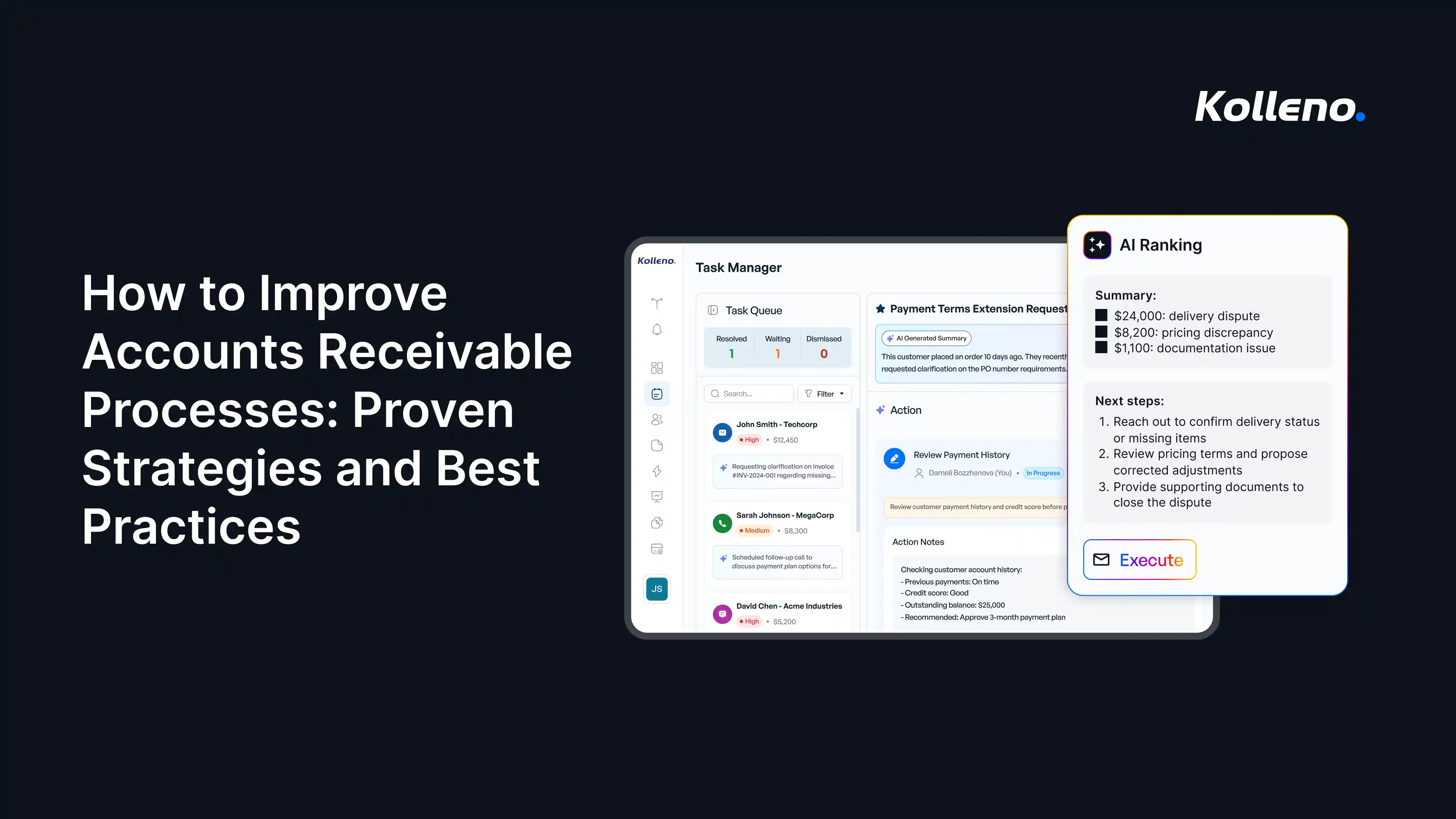
But AR automation doesn’t mean removing your team from the process; it means having AI Agents execute the repetitive, high-volume tasks, like sending reminders, matching payments, identifying exceptions, and flagging risk. Your team stays in control, orchestrating the process and focusing on the decisions that require human judgment.
Final Thoughts
Improving accounts receivable is not a one-time fix. It’s a set of interconnected disciplines that need to work together consistently, from credit policy and invoicing to collections, cash application, and reporting.
Where most businesses struggle is not in understanding what good looks like but in executing it at volume without the process breaking down.
How Kolleno Helps You Improve Your Accounts Receivable Process
Kolleno is an AI-forward, integrated order-to-cash platform built to run the full AR cycle more efficiently. Collections, cash application, payments, credit risk, dispute management, and forecasting all operate within one connected platform, pulling data directly from your ERP.
AI Agents act as force multipliers, executing outreach, matching payments, flagging risk accounts, and generating on-demand reports. Your finance team retains full control, defining the rules and priorities while the platform executes. In other words, you keep human expertise but with AI execution.
What’s more, Kolleno integrates with NetSuite, Microsoft Dynamics, Xero, QuickBooks, Sage Intacct, Oracle Fusion, and SAP.
Frequently Asked Questions About Managing Accounts Receivable
How do you improve accounts receivable?
Improving accounts receivable starts with four fundamentals:
- A clear credit policy applied consistently
- Accurate and immediate invoicing
- A structured collections process with defined escalation steps
- Regular reporting against key metrics like DSO and your AR aging report.
Technology and automation then allow you to execute these consistently at scale, without the process breaking down as invoice volumes grow.
What are the best practices for AR management?
The core best practices for AR management are:
- Set and enforce a documented credit policy
- Invoice accurately and immediately
- Follow up with customers before invoices become overdue
- Segment collections effort by risk and value
- Make it easy to pay by offering multiple payment methods
- Track DSO, CEI, and your AR aging report consistently.
Each of these is straightforward individually, but the challenge is maintaining all of them as the business scales.
How can automation help improve AR collections?
Automation handles the high-volume, repetitive tasks in AR collections, such as sending reminders on schedule, escalating overdue accounts according to predefined rules, matching payments to invoices, and flagging exceptions for human review.
This means consistent follow-up across every account, not just the ones your team remembers to action. It also frees your team to focus on complex disputes, strategic accounts, and decisions that require judgment.
What KPIs should I track for AR performance?
The most important AR KPIs are:
- Days sales outstanding (DSO)
- The collection effectiveness index (CEI)
- The AR aging report
- The bad debt ratio
DSO tells you how long it takes to collect on average, while CEI measures how much of available receivables you’re collecting. The aging report shows where overdue invoices are concentrating, and the bad debt ratio reveals how often credit decisions or collections processes are failing completely.
How can a credit policy reduce AR risk?
A documented credit policy reduces AR risk by ensuring that credit decisions are made consistently and based on evidence rather than instinct or relationship pressure. It sets clear thresholds for credit limits, defines what happens when a customer exceeds their limit or pays late, and creates a framework for reviewing credit exposure regularly.
Customers who represent high collection risk either don’t receive credit or receive it on tighter terms, which reduces the probability of bad debt before any collection effort is required.