










Your team issues invoices every day, but cash still lands later than you’d like. Disputes sit in inboxes, and nobody has a single view of which accounts are genuinely at risk. Those problems almost always hide in the AR process: the steps between extending credit and actually collecting cash.
An efficient AR process reduces days sales outstanding (DSO), protects cash flow, and provides finance teams with the visibility they need to make sound decisions. A fragmented one creates the opposite: slow collections, growing aged debt, and reactive firefighting.
In this guide, we’ll cover:
- What the accounts receivable process involves and why it matters
- The six key stages of the AR cycle
- How to optimize and automate your AR process
- Common challenges and how to address them
- The KPIs that tell you whether your AR process is working
What Is the Accounts Receivable Process?
The accounts receivable process is the end-to-end workflow a business uses to manage credit sales from invoice creation to cash collection. It begins when a customer is approved for credit and ends when their payment is received, applied, and reconciled.
The receivables process sits within the broader order-to-cash (O2C) cycle. It is the revenue-collection phase: the point where the goods or services have been delivered and the business is working to recover what it is owed.
How well this process runs determines the reliability of incoming cash and the accuracy of financial reporting.
The Six Key Stages of the Accounts Receivable Process Cycle
1. Customer Onboarding and Credit Assessment
Every AR cycle starts before the sale. When a new business customer requests credit terms, you need a formal credit assessment process. This means reviewing payment history, credit reports, and trade references. Based on the assessment, you’ll set a credit limit and agree on payment terms in writing before the first order is placed.
Customer data should be captured in your ERP or AR system at this stage: contact details, billing address, preferred payment method, and any special invoicing requirements. Getting this right upfront prevents friction later in the cycle.
2. Order Fulfillment and Service Delivery
AR can only be created once the business has fulfilled its obligation. For product businesses, that means confirming shipment and delivery. For service businesses, it means completing the scope of work or reaching a billing milestone.
Documentation matters here. A signed delivery receipt, a completion confirmation, or an approved timesheet creates a clear record that the obligation has been met. This documentation becomes critical if a customer later disputes an invoice.
3. Invoice Generation and Dispatch
Generate and send the invoice as soon as the obligation is fulfilled. Delays in invoicing are one of the most common and entirely avoidable causes of slow payments.
Deliver the invoice through the customer’s preferred channel: email, an online portal, or electronic data interchange (EDI) where required. Confirm receipt where possible. An invoice sitting in a spam folder or awaiting approval in a customer’s system is a payment that will arrive late through no fault of the customer.
4. Payment Tracking and Application
Once the invoicing process is done, the receivables team monitors due dates and records incoming payments. Cash application is the process of matching payments received to the specific invoices they settle.
This sounds straightforward, but in practice it requires careful attention, particularly when customers pay multiple invoices with a single payment, pay partial amounts, or reference incorrect invoice numbers.
All payments should be recorded in the AR system and reconciled with the general ledger. Outstanding balances should be updated immediately. Delays in cash application create a distorted view of what is still owed and can complicate the collections process.
5. Collections Management and Dispute Resolution
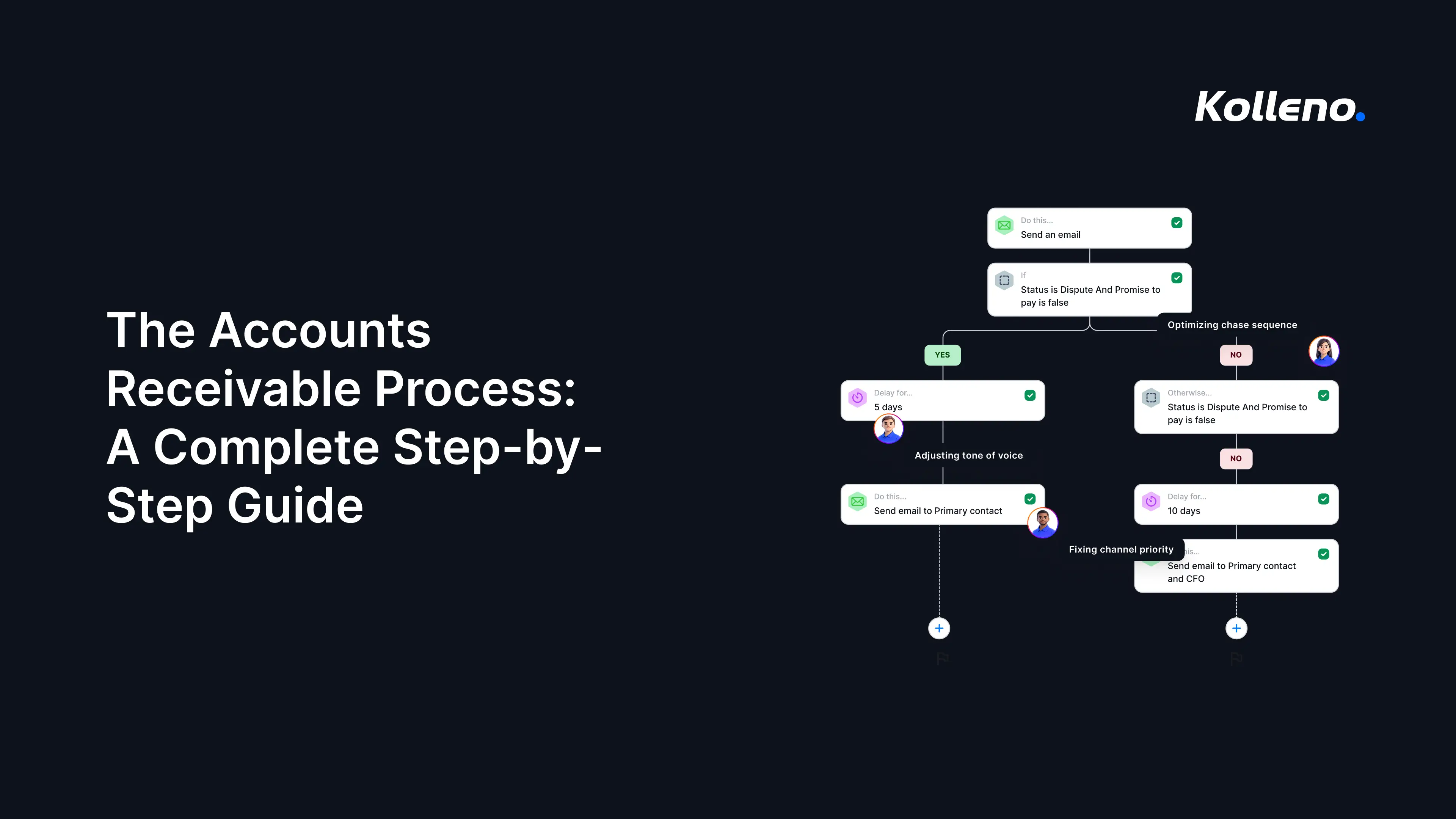
Collections begin when a payment is approaching its due date. An effective dunning process combines automated reminders with human judgment. The typical sequence runs from a pre-due-date reminder, through a due-date notification, to increasingly direct follow-up for overdue accounts.
Dispute resolution needs its own lane in the process. When a customer raises a dispute, billing error, or chargeback, it should be logged, routed to the right person, and resolved quickly. Unresolved disputes are one of the top reasons payments stall. A clear escalation path, with defined response times at each stage, keeps disputes from aging into bad debt.
Maintain a professional tone throughout. Collections done well preserve the customer relationship. The goal is payment, not confrontation.
6. Reporting, Analysis, and Write-offs
Regular reporting is what makes the receivables process visible and manageable. The AR aging report categorizes outstanding invoices by how long they have been unpaid: 0-30 days, 31-60 days, 61-90 days, and over 90 days. Review this report weekly and act on accounts in the later buckets straight away.
When an account is confirmed as uncollectible, it should be formally written off in accordance with the company’s write-off policy. Writing off a bad debt does not mean the customer no longer owes the money. It means the business has recognized it is unlikely to collect and has adjusted its financial statements accordingly.
How to Optimize the Accounts Receivable Process
An optimized receivables process is standardized, automated where appropriate, and continuously measured. Start by documenting your current process and identifying where delays most often occur. Common friction points include late invoicing, unclear payment terms, manual cash application, and slow dispute resolution.
Best Practices for Efficient AR Management
Invoice immediately after delivery. Automate reminders on a fixed schedule rather than relying on manual tracking. Offer multiple payment methods: ACH, credit card, and online portal access reduce the effort required for customers to pay. Conduct a monthly review of credit limits and payment terms for your highest-value customers.
AR Automation Software
AR automation platforms handle the repetitive tasks in the collection cycle:
- Sending reminders
- Matching payments to invoices
- Generating aging reports
- Flagging high-risk accounts.
Finance teams using automation can prioritize their attention on accounts that genuinely need human judgment, rather than spending time on routine outreach.
Key capabilities to look for include automated dunning with configurable escalation, payment portal integration, real-time aging visibility, dispute tracking, and ERP integration. Platforms with AI-driven prioritization help collections teams focus on the accounts where intervention has the most impact on cash recovery.
ERP and CRM Integration
AR does not operate in isolation. Customer data, order information, and payment history sit across multiple systems. Integrating your AR platform with your ERP and CRM ensures that AR teams have the full picture when managing accounts. It also removes the manual data transfers that introduce errors and slow the process.
Common Challenges in Accounts Receivable and How to Overcome Them
Late payments are the most visible AR challenge, but the root causes vary. Disputed invoices are a frequent culprit: customers who disagree with a charge will delay payment until it is resolved. Building a fast, clear dispute resolution process directly reduces the volume of overdue accounts.
Manual processes create blind spots. Teams managing AR through spreadsheets and email lack a consolidated view of what is outstanding, what is overdue, and where disputes are sitting. Centralizing data and automating key touchpoints addresses both problems.
Lack of standardized policies leads to inconsistency. Without a written credit policy, follow-up procedures, and write-off criteria, different team members handle the same situations differently. Standardization makes the process scalable and auditable.
Measuring Accounts Receivable Performance: Key KPIs
DSO is the primary AR KPI. It measures the average number of days it takes to collect payment after a sale:
(Accounts Receivable / Net Credit Sales) x Number of Days.
A rising DSO indicates slowing collections. The AR Turnover Ratio measures how many times AR is collected over a period: Net Credit Sales divided by Average Accounts Receivable.
The Collection Effectiveness Index (CEI) measures what percentage of the total collectible AR was actually collected in a given period. Unlike DSO, CEI adjusts for new AR generated during the period, making it a more precise measure of collections efficiency.
The Bad Debt Ratio tracks what percentage of AR is ultimately written off. A rising bad debt ratio may indicate credit policy needs tightening or that collections are escalating too late.
How Kolleno Supports the AR Process
Kolleno’s AI-powered order-to-cash platform automates and orchestrates the accounts receivable process from invoice to cash collection. It acts as an operational extension of your finance team rather than just another system to maintain.
Kolleno’s multi-agent AI workforce runs policy-based Agentic Workflows across collections, cash application, disputes, forecasting, and credit risk. Finance leaders define objectives and credit policies; Maestro AI orchestrates task-specific agents to prioritise at-risk accounts, route disputes, and accelerate cash application, with humans in the loop for strategic decisions.
The platform integrates with major ERPs including NetSuite, Microsoft Dynamics, Xero, QuickBooks, Sage Intacct, Oracle Fusion, and SAP, giving AR teams real-time visibility into the full accounts receivable process and reducing manual effort across the O2C cycle.
Final Thoughts on the Accounts Receivable Cycle
The accounts receivable process is where revenue becomes cash. Every delay in the cycle, whether at the invoicing stage, during collections, or in dispute resolution, costs the business real money in the form of extended DSO and reduced working capital.
Finance teams that standardize their AR process, measure it consistently, and use the right technology spend less time chasing and more time managing. If you want to see how Agentic Workflows in Kolleno’s O2C platform change the AR picture, book a demo.
Frequently Asked Questions
What are the steps in the accounts receivable process?
The accounts receivable process involves six main stages: customer onboarding and credit assessment, order fulfillment and service delivery, invoice generation and dispatch, payment tracking and cash application, collections management and dispute resolution, and reporting and write-offs. Each stage needs to be handled consistently to maintain healthy cash flow and accurate financial records.
What are the 5 C’s of accounts receivable management?
The 5 C’s of credit assessment are: Character (the customer’s willingness to pay, based on payment history), Capacity (their ability to pay, based on cash flow), Capital (their financial reserves), Conditions (market and economic factors affecting payment), and Collateral (assets that could secure the debt). These are used to evaluate credit risk before extending payment terms to a new customer.
How can businesses optimize their AR process?
Optimizing AR starts with standardizing the process: document each stage, define response times, and establish escalation paths. Invoice immediately after delivery. Automate reminders. Offer multiple payment methods. Review the aging report weekly. Use KPIs like DSO and CEI to track performance over time and identify where the process is slowing down.
What are the common challenges in managing accounts receivable?
The most common AR challenges include late payments caused by disputed invoices, manual processes that create errors and blind spots, inconsistent follow-up due to lack of standardized procedures, and difficulty prioritizing collections effort across large invoice volumes. Automation, clear credit policies, and real-time aging visibility address each of these directly.
- What Is the Accounts Receivable Process?
- The Six Key Stages of the Accounts Receivable Process Cycle
- How to Optimize the Accounts Receivable Process
- Common Challenges in Accounts Receivable and How to Overcome Them
- Measuring Accounts Receivable Performance: Key KPIs
- How Kolleno Supports the AR Process
- Final Thoughts on the Accounts Receivable Cycle
- Frequently Asked Questions