


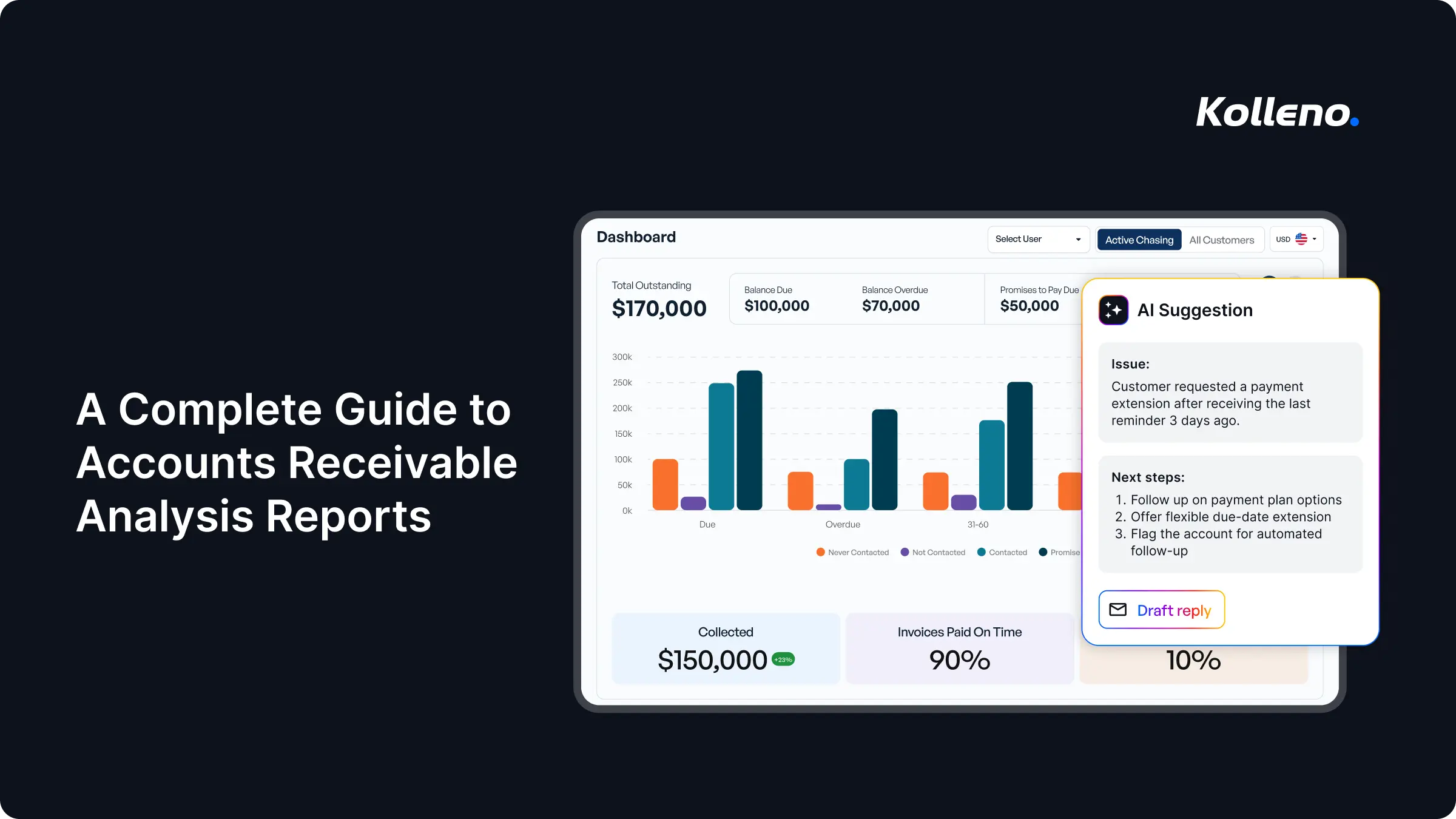
Most finance teams know their total AR balance, but fewer have a clear picture of which customers are driving collection risk, how long specific invoices have actually been outstanding, or what the data is telling them about payment behaviour trends.
That’s the gap an accounts receivable analysis report closes.
In this guide, we’ll cover what an accounts receivable analysis report is and why it matters, along with the main report types and when to use each one. We’ll also explore how to perform a step-by-step AR analysis, turning data into strategic decisions.
What Is an Accounts Receivable Analysis Report?
An accounts receivable (AR) analysis report is a financial document that provides a structured view of outstanding customer invoices.
When well-structured, it goes beyond a simple list of what’s owed, giving insight into who owes what, how long they’ve owed it, how that compares to previous periods, and what the data implies for cash flow, credit risk, and collection strategy.
Why It Matters
Without regular AR analysis, finance teams are managing receivables reactively, responding to individual overdue invoices rather than identifying the systemic patterns that cause DSO to drift upward or bad debt to accumulate.
An AR analysis report turns transaction data into management information that supports credit decisions, collection prioritisation, and cash flow forecasting.
The benefits compound over time, as finance teams that analyze AR consistently spot deteriorating customer credit profiles early, adjust payment terms before overdue balances become uncollectable, and build accurate cash flow models based on real payment behaviour rather than contractual payment terms.
Key Accounts Receivable Report Types
The AR Aging Report
The aging report is the foundational AR analysis document. It categorizes unpaid invoices by how long they’ve been past due (current, 1-30 days, 31-60 days, 61-90 days, and 91 or more days). This gives finance teams an immediate picture of where collection risk is concentrated and which accounts need urgent attention.
Aging buckets are typically calculated from the invoice due date rather than the invoice date, because the due date reflects when payment was actually expected. Calculating from the invoice date would understate how overdue an invoice is for customers with extended net terms.
DSO and Payment Performance Reports
Days sales outstanding (DSO) measures the average number of days it takes to collect payment after a sale. A DSO report tracks this metric over time, by customer, and by invoice cohort.
An increasing DSO is often a sign that collections are slowing and invoices are taking longer to convert into cash. However, even a stable DSO can mask underlying issues during periods of rapid revenue growth if collections are not keeping pace with rising invoice volumes.
DSO is typically calculated as: (AR balance / total credit sales) × number of days in the period
Customer-Level AR Reports
Customer-level reports break down AR by individual account. They show transaction history, payment patterns, current outstanding balance, and how much of that balance sits in each aging bucket. These reports are essential for credit reviews, key account management, and escalation decisions on high-value overdue balances.
Cash Reconciliation Reports
A cash reconciliation report matches incoming payments to open invoices, accounting for partial payments, credits, and unapplied cash. It surfaces discrepancies between what the bank received and what the ERP has recorded, ensuring the AR balance is accurate. Unapplied cash is a common source of overstated AR and understated cash.
Credit Risk Reports
Credit risk reports assess the risk profile of your customer base. They identify customers with deteriorating payment behaviour, high credit concentration, or exposure above approved credit limits. Used proactively, they allow finance teams to adjust credit terms before overdue balances accumulate rather than after.
Revenue Forecasting Reports
For SaaS and subscription businesses, AR analysis extends into recurring revenue metrics:
- Monthly recurring revenue (MRR)
- Annual recurring revenue (ARR)
- Customer lifetime value (CLV).
These reports connect AR performance to revenue retention and help finance teams model future cash inflows more accurately.
How to Perform an Accounts Receivable Analysis
Step 1: Gather All Outstanding Invoices
Start with a complete, accurate list of open invoices from your ERP or accounting system. This should include invoice number, customer, invoice date, due date, amount invoiced, amount paid, and balance outstanding.
Incomplete or inaccurate data at this stage undermines everything that follows.
Step 2: Group Invoices by Customer and Aging Bucket
Assign each invoice to an aging bucket based on days past due. Group invoices by customer so you can see the total outstanding balance and its distribution across aging buckets for each account. This customer-level view is essential for collection prioritisation.
Step 3: Calculate Key Metrics
With the data grouped, calculate DSO, the percentage of AR in each aging bucket, and the concentration of outstanding balances across your top customer accounts. Flag any customers with balances above their approved credit limit.
Step 4: Identify Trends and Red Flags
Compare the current period to previous periods.
Is DSO rising? Is the proportion of AR in the 61-90+ day bucket growing? Are the same customers appearing in overdue buckets repeatedly?
These trends reveal whether the AR function is improving, holding steady, or deteriorating.
Step 5: Translate Data into Actions
An AR analysis only adds value if it drives decisions. Prioritize collection follow-up on accounts with the highest overdue balances, then escalate accounts with large 61-90+ day balances. Review credit limits for customers with deteriorating payment behaviour and flag potential bad debts for provision. The analysis should produce a clear set of actions for the AR team.
Common Pitfalls
The most common analytical failure is relying on a single summary metric. For instance, a flat total AR balance can mask a significant deterioration in aging distribution. As such, always review the aging breakdown, not just the headline number.
Data quality issues create another common challenge in AR reporting. Unapplied cash, duplicate invoices, and unmatched credits can all distort the underlying data, making reports less reliable and potentially leading to the wrong conclusions. For that reason, reconciliation should take place before analysis, ensuring decisions are based on an accurate view of receivables.
Strategic Applications of AR Analysis
Cash Flow Management
An AR analysis report provides the input for accurate short-term cash flow forecasting. By applying expected collection rates to each aging bucket, finance teams can model likely cash receipts over the coming weeks with greater precision than simply assuming all AR will be collected on the due date.
Credit Risk and Bad Debt Management
AR analysis is the primary input for credit risk decisions. Customers whose payment behaviour is deteriorating, whose balances are concentrated in older aging buckets, or who are approaching or exceeding credit limits should trigger a credit review.
Proactive credit management based on AR analysis reduces bad debt exposure and avoids write-offs that could have been prevented.
Under GAAP, the aging schedule is also the standard methodology for calculating the allowance for doubtful accounts. Each aging bucket is assigned a historical loss rate, and the allowance is calculated by applying that rate to the outstanding balance.
Accurate AR analysis is therefore a financial reporting requirement as well as a management tool.
Collection Prioritisation
AR analysis helps AR teams direct effort to where it will have the most impact. A large balance in the 31-60 day bucket from a typically reliable customer is a different priority from a smaller balance in the 91+ day bucket from a customer with a history of slow payment. Analysis-driven prioritisation produces better collection outcomes than treating all overdue invoices as equally urgent.
The Future of AR Reporting: Why Businesses Automate Reporting and Analytics
What Automation Software Changes
Manual AR reporting is time-consuming and error-prone. Exporting data, building spreadsheets, and producing reports by hand consumes AR team capacity that would be better spent on analysis and action.
AR automation platforms generate aging reports, DSO dashboards, and customer-level analytics automatically and in real time, without requiring any manual compilation.
Integration with ERP and CRM systems means the data feeding these reports is always current. Finance leaders get an accurate picture of AR health at any moment rather than waiting for a month-end report that is already two weeks old by the time they see it.
Predictive Analytics
Advanced AR platforms use AI to move beyond descriptive reporting into predictive analytics. Rather than simply showing what is overdue, they estimate the probability and timing of payment based on historical payment patterns, customer behaviour, and external signals.
This enables more accurate cash flow forecasting and earlier identification of accounts that are likely to become collection problems.
Final Thoughts
An accounts receivable analysis report is the information infrastructure that makes proactive AR management possible, not a compliance exercise.
Finance teams that analyze their receivables consistently make better credit decisions, prioritise collection effort more effectively, and forecast cash flow more accurately than those who treat AR analysis as a month-end formality.
How Kolleno Approaches AR Analysis
Kolleno’s O2C platform provides finance teams with real-time AR analytics, aging visibility, and AI-driven payment predictions across their entire customer base.
The platform’s Maestro AI synthesises AR data to surface the accounts, trends, and risks that most need attention, so finance leaders spend less time compiling reports and more time acting on them.
In addition, integrations with NetSuite, Microsoft Dynamics 365, SAP, Oracle Fusion, Sage Intacct, Salesforce, and HubSpot ensure that AR data is accurate and current without manual exports.
Frequently Asked Questions
What is included in an accounts receivables analysis report?
A comprehensive AR analysis report typically includes;
- The aging schedule (outstanding invoices grouped by time past due)
- DSO metrics and trends
- Customer-level breakdowns of outstanding balances
- Cash reconciliation data
- Credit risk indicators
More advanced reports add predictive payment analytics, bad debt provisions, and revenue forecasting metrics such as MRR or CLV for subscription businesses.
How often should you run an AR analysis?
For most B2B businesses, weekly AR analysis is the minimum, while high-volume operations benefit from real-time or daily visibility.
Monthly analysis is generally insufficient because issues identified at month-end have already had weeks to compound. The frequency of review should match the speed at which collection problems can develop in your specific customer base and business model.
What is the difference between an AR aging report and an AR analysis report?
An AR aging report is a specific document that categorizes outstanding invoices by how long they’ve been past due. An AR analysis report is a broader term that may include aging data alongside DSO trends, customer-level breakdowns, credit risk assessments, cash reconciliation, and payment performance analysis. The aging report is typically a component of a fuller AR analysis.
How do you use AR analysis to reduce bad debt?
AR analysis identifies customers with deteriorating payment behaviour, high overdue balances, or credit exposure above approved limits.
Acting on these signals early, by adjusting credit terms, escalating collection effort, or initiating credit reviews, prevents overdue balances from progressing into uncollectable bad debt.
The allowance for doubtful accounts should be updated regularly based on aging data to ensure the balance sheet reflects a realistic view of collectability.
- What Is an Accounts Receivable Analysis Report?
- Key Accounts Receivable Report Types
- How to Perform an Accounts Receivable Analysis
- Strategic Applications of AR Analysis
- The Future of AR Reporting: Why Businesses Automate Reporting and Analytics
- Final Thoughts
- How Kolleno Approaches AR Analysis
- Frequently Asked Questions