









Cash application should be simple: match incoming payments to invoices, post the receipt, move on.
But in large enterprises, it rarely is.
Payments arrive with incomplete remittance data. Customers pay multiple invoices at once. And teams often have to reconcile transactions across multiple systems before they can update the general ledger. At the same time, the finance function needs cash flow visibility and faster financial reporting — with auditors and regulators demanding tighter controls.
This is why AI agents are showing up in cash application and reconciliation. Not because “AI is exciting”, but because finance teams are still spending hours on manual matching and exception handling that doesn’t scale. The result is growing unapplied cash, misapplied payments, and unreliable cash visibility — which then creates downstream noise in revenue recognition.
In this guide, we’ll break down:
- What AI agents for cash application actually are
- The key features enterprise finance departments should demand
- How to compare cash application software (without getting fooled by marketing)
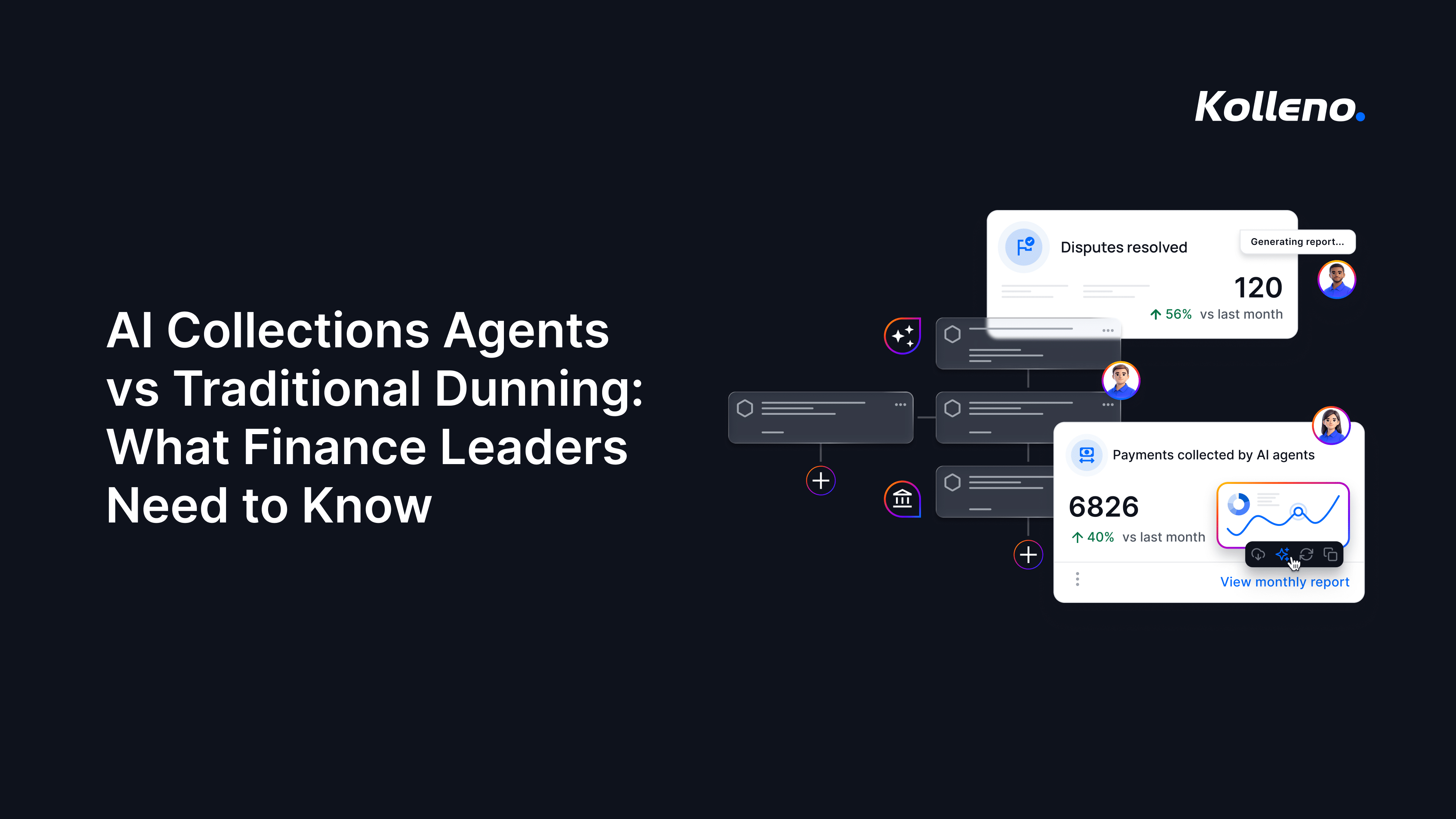
- What “good” looks like in practice — including examples from Kolleno’s AI Agent, which is positioned as execution-led AI for collections and reconciliation workflows.
What are AI agents for cash application?
AI agents for cash application are AI systems that don’t just highlight what needs doing — they actively drive parts of the cash application process, with guardrails. Instead of relying on rigid rules or manual matching, the agent can ingest incoming payments, interpret remittance data, and propose or execute the actions needed to apply cash correctly. In practical terms, that means automating repetitive tasks like extracting invoice reference details from remittance advice, deciding how to allocate partial payments, and routing exceptions for human review.
This matters because cash application is rarely straightforward in large enterprises. Payments arrive with missing information. One payment may cover multiple invoices. Remittance advice often lives in unstructured data — emails, PDF attachments, customer portals — rather than structured fields your ERP can easily use.
That’s where AI agents in finance outperform most automation tools. With natural language and machine learning techniques, modern finance AI agents can interpret messy text, use historical patterns, and match payments with far less manual effort. The best cash application software then supports human oversight through approval processes, role based access controls, and audit trails.
The end goal isn’t to remove the finance function from the loop. It’s to take work off finance teams without losing control. When AI agents work well in cash application, you get automated cash application and automated reconciliation that improves cash flow visibility, reduces unapplied cash, and strengthens cash forecasting. Finance leaders can trust the numbers because the AI agent’s decisions remain transparent, auditable, and integrated into existing systems.
Feature comparison guide: how to evaluate AI agents for cash application (enterprise checklist)
Enterprise finance teams don’t need more “AI-powered” claims. They need proof that a system can handle real cash application complexity: messy remittance data, multiple invoices per payment, partial payments, and constant exceptions — without creating risk.
Use the checklist below as a feature comparison rubric when evaluating cash application software. The strongest solutions won’t just automate the easy matches. They’ll reduce manual intervention in the exceptions, while preserving human oversight, audit trails, and data governance.
1) Remittance data capture across all channels
What it is: Ability to ingest remittance advice from emails, PDFs, portals, EDI, and bank notes — not just structured feeds.
Why it matters: In large enterprises, remittance data is often unstructured data. If the agent can’t access it, matching collapses and manual matching returns.
Demo question: “Show me how your AI agent captures remittance advice from a PDF and an email thread — then turns it into usable matching inputs.”
2) Invoice reference extraction (even when incomplete)
What it is: Extraction of invoice reference numbers, customer identifiers, dates, and amounts from noisy remittance text.
Why it matters: Missing or partial invoice reference data is one of the biggest cash application pain points.
Demo question: “What happens when the customer includes the wrong invoice reference — or only partial IDs?”
3) Matching logic that supports multiple invoices per payment
What it is: Payment matching across batches, where one payment covers multiple invoices.
Why it matters: Bulk payers are common in enterprise AR. The AI agent must match payments reliably, or you’ll build unapplied cash faster than you can clear it.
Demo question: “Can your system allocate a single payment across 20 invoices, including deductions?”
4) Partial payments handling
What it is: Built-in logic for partial payments, underpayments, and overpayments.
Why it matters: Partial payments create the highest manual effort in cash application processes. They also distort cash flow visibility when not handled cleanly.
Demo question: “Show me how you treat a partial payment where no explanation is provided in the remittance advice.”
5) Confidence scoring and explainable matching
What it is: The system shows why it matched a payment and how confident it is (not just a suggestion list).
Why it matters: For enterprise finance departments, transparency is the difference between usable automation and a black box AI system nobody trusts.
Demo question: “Can your AI agent explain the matching rationale using financial data and payment history?”
6) Exception routing (the real differentiator)
What it is: Automatic triage and routing of exceptions, with clear ownership and workflow steps.
Why it matters: Most automation tools perform fine on happy paths. AI agents work when the exceptions are handled faster and with less manual intervention.
Demo question: “Show me your exception workflows for unapplied cash, deductions, and mismatched customers.”
7) Automated reconciliation support
What it is: Agent-led workflows to reconcile cash application outcomes and update account status correctly.
Why it matters: Automated cash application without automated reconciliation still leaves finance teams doing manual clean-up, delaying month-end and financial reporting.
Demo question: “How does your platform support cash reconciliation and reduce reconciliation backlog?”
8) Real-time visibility into unapplied cash and cash positions
What it is: Dashboards showing applied vs unapplied cash, exception queues, and cash positions with real time data.
Why it matters: Finance leaders want cash flow visibility and strong cash forecasting. You can’t forecast what you can’t see.
Demo question: “Can I see real time visibility into unapplied cash by entity, customer, and payment channel?”
9) Audit trails at action level (not just event logs)
What it is: Full audit trails covering what was ingested, matched, routed, approved, and posted.
Why it matters: Enterprise adoption depends on trust. Audit trails support compliance and reduce risk management concerns.
Demo question: “Can you export an audit trail for one payment from remittance ingestion through to posting?”
10) Human oversight and approval processes
What it is: Configurable approvals for high-value matches, policy exceptions, write-offs, and unusual matching.
Why it matters: The finance function needs automation with control. Human oversight makes implementing AI safe.
Demo question: “Where is human review required, and can thresholds be configured by role or amount?”
11) Role based access controls (RBAC)
What it is: Permissions by role and segregation of duties.
Why it matters: Role based access controls are essential for data governance and protecting financial processes from unapproved actions.
Demo question: “How do you prevent collectors or junior users from approving postings into the general ledger?”
12) Seamless ERP integration (two-way sync)
What it is: Two-way integration with ERP and finance platforms, including posting and status updates.
Why it matters: Enterprise cash application must sit inside existing systems, not alongside them. Without seamless ERP integration, data accuracy suffers and finance teams lose confidence.
Demo question: “Show me the full workflow from incoming payments → match → post to ERP → update general ledger.”
13) Revenue recognition alignment
What it is: Correct handling of timing, allocations, and postings that impact revenue recognition.
Why it matters: In large enterprises, revenue recognition is tightly tied to how and when cash is applied. Errors here create financial reporting risk.
Demo question: “How do you ensure cash application does not introduce revenue recognition errors?”
14) Customer payment behavior intelligence
What it is: Ability to use payment patterns, payment history, and customer payment behavior to improve matching and prioritisation.
Why it matters: AI agents in finance become more valuable when they use context, not just rules. This also supports early payment discounts and collections strategy.
Demo question: “Can your system learn matching improvements from customer behavior over time?”
15) Data governance and data quality safeguards
What it is: Controls for data accuracy, field-level validation, change logs, and master-data hygiene.
Why it matters: AI agents rely on clean inputs. Without governance, automating cash application can amplify errors at scale.
Demo question: “What safeguards prevent misapplied payments from being posted automatically?”
16) Exception reduction over time (learning loop)
What it is: Demonstrable reduction in manual effort over time as the AI agent improves.
Why it matters: Enterprise buyers want cost savings and scalable operational performance. If exceptions don’t fall, the AI is not doing enterprise-grade work.
Demo question: “What does improvement look like after 30/60/90 days? Can you show reference data?”
17) Performance reporting for finance teams
What it is: Built-in reporting aligned to operational KPIs: payments auto matched, manual intervention rate, unapplied cash trend, exception resolution time.
Why it matters: Implementing AI without measurement creates skepticism. Modern finance teams need to prove business value and adoption.
Demo question: “Which KPIs do you recommend tracking for automated cash application success?”
18) Operational readiness (support model + rollout)
What it is: Onboarding, change management, and long-term vendor support.
Why it matters: Even the best cash application capabilities fail if implementation drags on or support is weak.
Demo question: “What does implementing AI look like for large enterprises, and what ongoing support do you provide?”
Vendor scorecard: a simple way to compare AI agents for cash application
Once you’ve shortlisted a few options, the next step is to score vendors against the same criteria. This turns demos into evidence, not impressions — and helps finance leaders align stakeholders across finance operations, AR teams, and IT.
Use the scorecard below as a readymade evaluation tool. Score each category from 0–5 (0 = missing, 5 = best-in-class), then compare totals across vendors.
| Category | What to evaluate | What “good” looks like | Questions to ask in the demo | Score (0–5) |
| Remittance data capture | Ability to ingest remittance data across channels | Captures remittance advice from emails, PDFs, portals, EDI, and bank notes | “Show me how you ingest remittance advice from a PDF and a portal.” | |
| Unstructured data interpretation | Natural language extraction quality | Extracts invoice reference, amounts, and notes from messy text reliably | “Can it handle vague or incomplete remittance descriptions?” | |
| Payment matching | Matching logic beyond perfect data | Can match payments even when invoice reference is missing or wrong | “What happens when there’s no invoice number?” | |
| Multiple invoices allocation | Handling bulk payments across invoices | Correctly allocates one payment across multiple invoices with reasoning | “Show allocation across 20 invoices in one payment.” | |
| Partial payments handling | Underpayments / split payments | Applies partial payments cleanly; keeps balances accurate | “How do you handle a partial payment with no explanation?” | |
| Manual intervention rate | How often humans must step in | Demonstrably reduces manual matching and manual effort over time | “What % of payments require manual intervention after 60 days?” | |
| Exception routing | Workflow for edge cases | Routes unapplied cash and exceptions to the right owner automatically | “Show your exception queues and routing rules.” | |
| Automated reconciliation | Reconciliation support post-application | Supports automated reconciliation and reduces unapplied cash backlog | “How do you support cash reconciliation end-to-end?” | |
| Human oversight controls | Approval processes + guardrails | Thresholds, approval workflows, and safe automation boundaries | “Where is human oversight required, and can we configure it?” | |
| Audit trails | Auditability of agent actions | Action-level audit trails: what data was used, why it matched, who approved | “Export an audit trail for one payment from ingestion to posting.” | |
| Data governance | Accuracy + controls | Validation rules, change logs, error prevention for misapplied payments | “What controls prevent incorrect auto-posting?” | |
| Role based access controls | Permissions and segregation of duties | RBAC with strict posting/approval permissions | “How do you enforce segregation of duties in cash application?” | |
| Seamless ERP integration | Integration into existing systems | Two-way sync with ERP/general ledger; no CSV-based workarounds | “Show matching → posting → general ledger update in real time.” | |
| Multiple systems support | Enterprise architecture readiness | Works across multiple systems without duplicate manual data entry | “How do you support ERP + billing + payment provider workflows?” | |
| Revenue recognition impact | Alignment with revenue recognition | Posting logic supports clean revenue recognition and financial reporting | “How do you avoid revenue recognition errors from cash application?” | |
| Cash flow visibility | Reporting and dashboards | Real time visibility into cash positions, unapplied cash, and status | “Can we drill into unapplied cash by entity and customer?” | |
| Financial reporting depth | Reporting quality for finance leaders | Reliable reporting for close, audit, and forecasting | “Which reports are built in vs needing BI tools?” | |
| Business value proof | Evidence of outcomes | Clear case studies: cost savings, reduced unapplied cash, faster close | “What measurable outcomes do enterprise customers achieve?” | |
| Implementation & support | Readiness for enterprise rollout | Strong onboarding, ongoing support, and clear ownership post-go-live | “What does implementing AI look like in the first 90 days?” |
How Kolleno’s AI Agent supports cash application (and why it matters for enterprise finance teams)
Kolleno positions its AI Agent as an execution-led system for AR — not just a layer that surfaces insights. In its own words, Kolleno claims it’s the only platform where you can “assign AI Agents to fully automate collections and reconciliation processes with Agentic Workflows.” That matters for cash application because reconciliation is where most enterprise teams get stuck: payments arrive, but remittance data is incomplete, exceptions pile up, and unapplied cash grows.
On the cash application side specifically, Kolleno frames AI as something that can automatically extract and analyse remittance data from messy sources like emails, PDFs, customer portals, and payment references — the real-world inputs that break traditional cash application software. Instead of pushing finance teams back into manual matching and manual data entry, the goal is to help teams match payments to invoices more accurately, keep account status clean, and reduce manual intervention in exception handling.
For finance leaders, the value isn’t only operational efficiency — it’s governance and trust. Kolleno’s “agentic workflow” framing implies cash application actions remain controlled via human oversight, workflow rules, and audit-ready traceability. When that’s in place, automated cash application becomes a lever for better cash flow visibility, faster financial reporting, and stronger cash forecasting — because the numbers in your ERP and general ledger reflect reality sooner, with fewer reconciliation surprises.
Final thoughts
Cash application is one of the last big bottlenecks in enterprise finance operations. When it breaks, finance teams lose cash visibility and confidence in the numbers.
That’s why the best cash application software in 2026 won’t just automate matching. It will use AI agents to reduce manual intervention and clear unapplied cash faster, with audit-ready governance built in.If you want to see what that looks like in practice, book a demo of Kolleno to explore how Kolleno’s AI Agent supports cash application and reconciliation — and how it can improve cash flow visibility at scale.
- What are AI agents for cash application?
- Feature comparison guide: how to evaluate AI agents for cash application (enterprise checklist)
- 1) Remittance data capture across all channels
- 2) Invoice reference extraction (even when incomplete)
- 3) Matching logic that supports multiple invoices per payment
- 4) Partial payments handling
- 5) Confidence scoring and explainable matching
- 6) Exception routing (the real differentiator)
- 7) Automated reconciliation support
- 8) Real-time visibility into unapplied cash and cash positions
- 9) Audit trails at action level (not just event logs)
- 10) Human oversight and approval processes
- 11) Role based access controls (RBAC)
- 12) Seamless ERP integration (two-way sync)
- 13) Revenue recognition alignment
- 14) Customer payment behavior intelligence
- 15) Data governance and data quality safeguards
- 16) Exception reduction over time (learning loop)
- 17) Performance reporting for finance teams
- 18) Operational readiness (support model + rollout)
- Vendor scorecard: a simple way to compare AI agents for cash application
- How Kolleno’s AI Agent supports cash application (and why it matters for enterprise finance teams)
- Final thoughts